


2. 广东雷州珍稀海洋生物国家级自然保护区管理局, 广东雷州 524256;
3. 广西海洋药物重点实验室, 广西南宁 530022;
4. 海洋中药资源高效利用广西高校工程研究中心, 广西南宁 530022
2. Guangdong Leizhou Rare Marine Organisms National Nature Reserve Administration, Leizhou, Guangdong, 524256, China;
3. Guangxi Key Laboratory of Marine Drugs, Nanning, Guangxi, 530022, China;
4. Guangxi University Engineering Research Center for High-efficient Utilization of Marine Traditional Chinese Medicine Resources, Nanning, Guangxi, 530022, China
八放珊瑚纲(Octocorallia)是热带及亚热带海域中具有重要生态功能的底栖生物类群,广泛分布于珊瑚礁、岩礁及陆坡等多种海洋生态系统中[1-2]。该群体形态多样、结构复杂,在维持海洋生境的三维结构、提供庇护与附着空间、促进营养物质在生态系统中的传递等方面发挥关键作用[1, 3]。多数八放珊瑚偏好栖息于基底稳定坚硬、水动力条件适中且水体交换能力良好的海域,从浅层海域(水深5—30 m)至中层海域(水深200 m)甚至更深海域均有分布[4]。作为中国南海的重要生物类群,八放珊瑚的区系组成在海南岛、西沙海域等地已有较多研究[5-6],但在北部湾、雷州半岛等华南沿岸区域的珊瑚调查与系统记录仍相对不足,这些区域的潜在珊瑚多样性水平可能被低估。
鞭柳珊瑚科(Ellisellidae)是八放珊瑚中形态多样性和生态适应性均较突出的类群,常形成丛状、扇状或鞭状群体,广泛分布于热带至温带的浅层海域及中层海域[7]。在传统分类中,鞭柳珊瑚科的鉴定主要依赖于分枝模式、群体结构、珊瑚虫排列,以及共肉组织和珊瑚虫内骨针的类型与尺寸[8]。然而,由于多属之间存在显著的形态趋同与平行演化现象,仅依赖形态学特征可能导致属间及种间划分存在不确定性[9]。近年来,随着深海调查和水下采样工作的不断推进,全球鞭柳珊瑚科的物种记录持续增加[10-12],但其系统发育关系与区系组成仍存在许多问题尚待厘清。
在八放珊瑚分子系统发育研究中,mtMutS基因是目前分辨率较高的重要分子标记之一[13]。相较于COI、16S rRNA等传统线粒体基因在八放珊瑚中高度保守、种间关系难以解析的局限,mtMutS基因具有更高的序列变异度和更稳定的系统发育信号,因而被广泛应用于属际关系厘清、隐存种识别及形态相近类群的分子鉴定[14]。研究显示,mtMutS基因能够有效区分鞭柳珊瑚科多个属,如灯芯柳珊瑚属(Junceella)、双叉珊瑚属(Dichotella)、丛鞭珊瑚属(Nicella)、鞭柳珊瑚属(Ellisella)、柔鞭珊瑚属(Viminella)、栉柳珊瑚属(Ctenocella)等,并与形态学证据相互补充,从而提高分类鉴定的可靠性[7]。
疣柳珊瑚属(Verrucella)目前全球已报道21个有效种,主要分布于印度洋与西太平洋海域,分布范围从浅层海域至中层海域(水深200 m)[15]。该属的典型特征包括分枝间吻合形成网状结构、终端分枝短钝、共肉组织中含大量双头形骨针、珊瑚虫内骨针以纺锤形为主等[16-17]。但疣柳珊瑚属在中国海域的分布状况长期缺乏可靠文献支撑,是海洋生物调查的薄弱类群。
广东雷州珍稀海洋生物国家级自然保护区位于北部湾东缘、雷州半岛西岸,是华南近岸典型的硬基底与珊瑚礁复合生境,具备适宜八放珊瑚类群定居的自然条件。目前,该区域的鞭柳珊瑚科多样性尚未得到系统研究,可能存在未被记录的物种。本研究以在该保护区珊瑚礁调查中采集的2株疣柳珊瑚属样本为对象,通过形态学特征与mtMutS基因系统发育分析,明确其分类地位,并确认其是否为中国海域的新纪录种。本研究可为完善我国八放珊瑚区系组成、解析北部湾区域八放珊瑚多样性格局及后续分类学研究提供重要参考。
1 材料与方法 1.1 样品采集与保存本研究中的2株疣柳珊瑚属样本于2024年9月在雷州半岛浅层海域(水深5—15 m)通过水肺潜水采集。采集前先对样本原位拍照记录。出水后,样本立即保存于99%乙醇溶液中并编号,现保存于广西中医药大学海洋中药资源分类实验室。
1.2 样品处理与鉴定将疣柳珊瑚属样本带回实验室,首先拍摄样品,记录其分枝、颜色等形态特征;其次用Leica S9i体视显微镜(德国徕卡公司)观察并拍摄其中轴及珊瑚虫形态;最后分离出样本的珊瑚虫、共肉组织表面及内层,将不同组织的骨针置于5%次氯酸钠溶液进行消化,经去离子水反复冲洗后,用Leica DM1000生物显微镜(德国徕卡公司)观察并拍摄[18]。本研究所采用的分类学术语主要参照Bayer等[19]的研究成果。
1.3 DNA提取与测序采用海洋动物组织基因组DNA提取试剂盒[DP324,天根生化科技(北京)有限公司]提取样本的基因组DNA,并委托北京诺禾致源科技股份有限公司进行文库构建与高通量测序。测序在MGI T7+平台上完成,采用双端测序(PE150)策略,每个样本获得40 M原始测序数据。
1.4 系统发育分析首先,采用fastp v1.0.1在默认参数下对原始测序数据进行质量控制[20]。其次,使用GetOrganelle v1.7.7.1以NC_062009.1(芽生双叉珊瑚Dichotella gemmacea)为seed组装线粒体基因组,并从中准确定位和提取mtMutS基因[21]。以垂柳珊瑚(Heliania sp.)的mtMutS基因序列作为外群。获得的序列采用MAFFT v7.526进行多序列比对,并利用trimAl v1.5对结果进行剪裁[22-23]。采用IQ-TREE v2.0.1进行系统发育分析,在最大似然框架下进行推断[24];模型选择与分区合并采用-mMFP+MERGE策略[25]。分支支持度通过超快速自助法1 000次和SH-aLRT 1 000次联合评估[26-27],并启用--bnni对自助树拓扑进行优化[28],同时启用--safe以提高树搜索的稳健性[24]。最后,将所得系统发育树文件上传至iTOL平台进行可视化展示[29]。
2 结果与分析 2.1 形态学鉴定结果刺胞动物门Cnidaria Hatschek, 1888
珊瑚虫亚门Anthozoa Ehrenberg, 1834
八放珊瑚纲Octocorallia Haeckel, 1866
硬软珊瑚目Scleralcyonacea McFadden, van Ofwegen & Quattrini, 2022
鞭柳珊瑚科Ellisellidae Gray, 1859
疣柳珊瑚属Verrucella Milne Edwards & Haime, 1857
伞形疣柳珊瑚Verrucella umbracula (Ellis & Solander, 1786)
报道记录:Umbracella umbraculum (Ellis & Solander, 1786): 80[30];
Rhipidigorgia umbraculum (Ellis & Solander, 1786): 178[16];
Gorgonia umbracula Ellis & Solander, 1786:80[30];
Gorgonella umbraculum (Ellis & Solander, 1786): 381[31];
Gorgonella umbracula (Solander & Ellis): 27[32];
Ctenocella umbraculum (Ellis & Solander, 1786): 80[30];
Verrucella umbracula: Bayer, 1955:215, pl.5[33]; Bayer & Grasshoff, 1994:35-37, figs. 8, 9[34]; Song 1981:105, 108, 110[35]; Imahara, 1996:31[36]; Ramvilas et al, 2023:104-105[37]。
模式动物产地:印度—太平洋印度尼西亚海域。
采集信息:编号为20240916-LZ-2-01,采样时间为2024-09-16,地理坐标为20°30′27″N、109°43′36″E,水深为10 m; 编号为20240916-LZ-2-02,采样时间为2024-09-18,地理坐标为20°30′37″N、109°42′45″E,水深为9.8 m。采集方式均为水肺潜水。
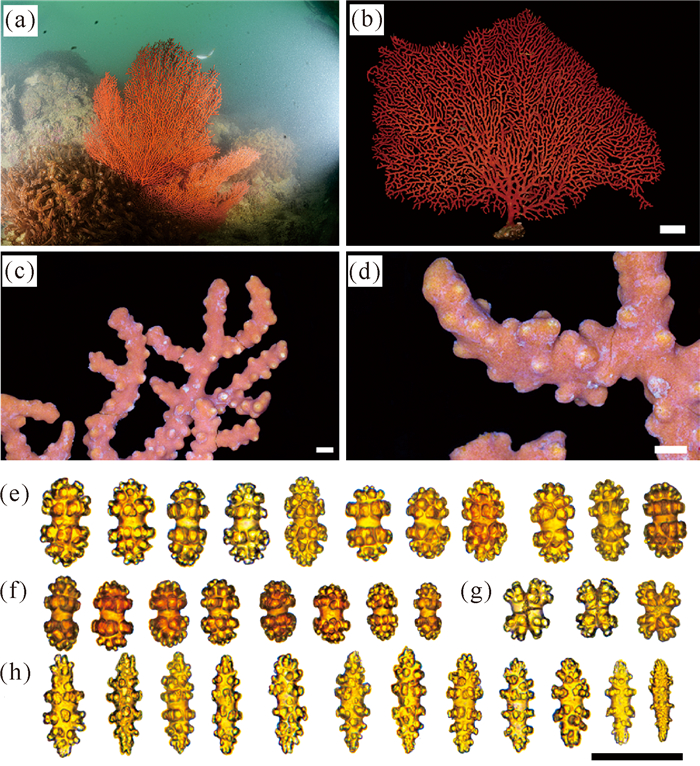
形态描述:编号为20240916-LZ-2-01的样本长度为18.8 cm,宽度为23.2 cm;基底呈不规则椭圆形,直径为2.8 cm;从基底发出一个主枝,基底到第一分枝的距离为0.9 cm;所有分枝均交叉生长、吻合,形成网状结构,分枝间的角度为30°—120°,间距为0.5—1.5 cm [图 1: (a)、(b)]。终端分枝呈圆柱形,末端圆钝,长度为0.4—1.6 cm,直径为0.2—0.4 cm [图 1(c)]。编号为20240916-LZ-2-02的样本长度为20.3 cm,宽度为25.6 cm,为单扇形,分枝密集;珊瑚虫形态单一,可收缩,圆锥状,略微隆起,分布在分枝的四周,在较大的分枝上分布稀疏,在较小的分枝上分布密集;相邻珊瑚虫之间的距离为0.21—0.73 mm,珊瑚虫直径为0.48—0.63 mm [图 1(d)]。共肉组织表面密布大量对称的双头形骨针,中间具有狭窄而光滑的腰带,两端密布疣状突起,长度为0.07—0.10 mm [图 1(e)]。共肉组织内层含大量较小且对称的双头形骨针,长度为0.04—0.06 mm [图 1(f)];以及少量规则的十字形骨针,两端布满疣状突起,长度为0.06—0.07 mm [图 1(g)]。珊瑚虫具有大量细长的双头形骨针,形状类似于纺锤形,长度为0.08—0.12 mm [图 1(h)]。
|
| (a) In situ collected samples; (b) Collected samples; (c) Terminal branch under optical microscope; (d) Polyps under optical microscope; (e) Elongated double heads; (f) Short double heads; (g) Cross-shaped; (h) Spindles.(e)—(g) Sclerites of the coenenchyme; (h)Sclerites of the polyps.Scale bars: (b) 3 cm; (c)、(d) 1 mm; (e)—(h) 0.1 mm. 图 1 伞形疣柳珊瑚的外部形态、珊瑚虫和骨针 Fig.1 External morphology, polyps and sclerites of V. umbracula (Ellis & Solander, 1786) |
颜色:样本活体时均呈橙黄色[图 1(a)],经过酒精浸泡后呈暗红色[图 1(b)]。骨针颜色呈淡黄色或橙红色[图 1:(e)—(h)]。
生境:生活在覆盖有许多角孔珊瑚生长的区域,依附于珊瑚礁的岩石上生长[图 1(a)]。
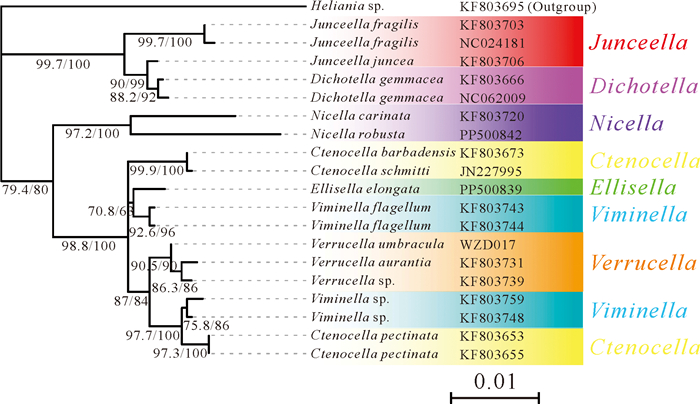
2.2 系统发育树分析系统发育树结果(图 2)显示,鞭柳珊瑚科内部存在明确且支持度高的系统关系,所有已确认的属均形成支持度高的单系群。灯芯柳珊瑚属与双叉柳珊瑚属位于系统发育树的基部位置,二者的分支节点支持度均接近或超过99%,反映了其深层分化历史,与既有形态学分类体系高度吻合。丛鞭柳珊瑚属也构成独立且支持度较高的单系群。栉柳珊瑚属和柔鞭珊瑚属为多系群。
|
| 图 2 基于mtMutS基因构建的鞭柳珊瑚科系统发育树 Fig.2 Phylogenetic tree of the Ellisellidae inferred from the mtMutS gene |
本研究采集的伞形疣柳珊瑚(样本编号为20240916-LZ-2-01)稳定嵌入疣柳珊瑚属的单系分支内部,与橙疣柳珊瑚(V. aurantia)和一条未定种疣柳珊瑚序列共同形成支持度高的聚类。该分支的节点支持度超过90%,表明伞形疣柳珊瑚与属内其他成员之间具有明确且稳定的系统关系。伞形疣柳珊瑚在拓扑结构中的位置排除了其与柔鞭珊瑚属、鞭柳珊瑚属和栉柳珊瑚属等形态相似类群归并的可能性,进一步强调了其在分子层面上与典型疣柳珊瑚属类群的一致性。值得注意的是,伞形疣柳珊瑚与橙疣柳珊瑚虽然处于同一分支,但是二者仍表现出可辨识的遗传分化,其分支长度和内部结构均表明两者在种级水平上保持独立性。这一分子证据与其独特的群体形态及骨针特征相互印证,支持其作为独立种的有效性。本研究不仅在中国南海海域采集到伞形疣柳珊瑚标本,更通过系统发育分析明确了其分类归属与演化分化地位,多维度数据共同支撑并证实了该物种在中国南海的首次可靠分布记录(表 1)。
3 讨论
鞭柳珊瑚科是浅海及中层海洋环境中分布广泛的一类八放珊瑚,其系统分类长期依赖于骨针类型、分枝模式及共肉组织结构等形态特征[8, 34]。在该科中,柔鞭珊瑚属、鞭柳珊瑚属、栉柳珊瑚属、疣柳珊瑚属等属均以对称双头形及纺锤形为主要骨针类型,属间差异主要体现在分枝是否吻合、网状结构的发育程度及骨针长度比例等性状上[7-8]。其中,疣柳珊瑚属的典型形态特征包括:共肉组织以双头形骨针为主;珊瑚虫以纺锤形骨针占优势;群体分枝通常发生吻合,形成具辨识度的网状结构;终端分枝短而钝圆[16-17]。本研究样本在分枝吻合模式、网状结构密度、珊瑚虫骨针形态及骨针尺寸范围等关键特征上均与上述属级鉴定特征一致,因此可明确归入该属。
伞形疣柳珊瑚是印度—太平洋区域广泛分布但记录相对稀少的种类。最早的文献中仅有其名称及简单描述,缺乏可比对的标准化形态资料[30]。直至Bayer等[34]基于马来西亚海域的标本建立该种的新模并给出系统的形态学描述后,该物种的形态性状才相对清晰。该物种的显著特征包括:群体呈扇形展开,分枝高度吻合、交错,形成致密的扇状网格;纺锤形骨针长度一般为0.095—0.128 mm;短双头及长双头骨针多分布于共肉组织中,呈淡黄色;珊瑚虫小型,可收缩,均匀分布于分枝表面。
从生态与生境角度来看,柳珊瑚目(Gorgonacea)类群多附着于浅层海域至中层海域的硬底生境,常见于岩礁、陡坡或礁体外缘等基质稳定区域,并依赖较强的水动力条件以实现高效的悬浮物滤食活动[17, 38]。与依赖共生藻的造礁石珊瑚不同,柳珊瑚目类群多为无共生藻类型,对光照条件的依赖程度较低,因此能够在半遮蔽或中、低光照环境中稳定分布[38-39]。本研究采样点位于中国南海北部海域,该区域受季风环流及沿岸流影响,水体交换频繁,整体水动力条件明显,同时分布有岩质海底及局部礁体,为柳珊瑚目及其近缘类群提供了适宜的附着基质与水文环境。该区域具备支持疣柳珊瑚属种群长期存续的基本生态基础,因此本研究记录的疣柳珊瑚更能反映该物种在中国南海北部的真实分布状况,而非偶发性出现。
鞭柳珊瑚科的系统发育研究表明,该科多个属之间存在趋同演化和平行进化现象,导致传统形态特征在属间区分中具有一定局限性[9]。因此,未来开展鞭柳珊瑚科分类与多样性研究时,建议结合线粒体全基因组标记、超保守元件(UCEs)等分子手段,以弥补单纯依赖形态学分析所带来的不确定性[40-41]。这对形态相近且分布范围重叠的柳珊瑚目类群的准确鉴定尤为重要。
4 结论本研究对广东雷州珍稀海洋生物国家级自然保护区采集的2株疣柳珊瑚属样本进行系统的形态学分析,明确了伞形疣柳珊瑚在雷州半岛及中国南海海域的分布,完善了我国八放珊瑚区系的物种记录体系。标本的群体形态、分枝结构、珊瑚虫排列以及骨针特征均与既往国外文献中的描述高度一致。基于mtMutS基因获得的鞭柳珊瑚科系统发育树,清楚地验证了伞形疣柳珊瑚在鞭柳珊瑚科中的确切分类位置,分子证据与形态诊断结果高度一致,为确认其分类归属及其在中国南海海域的新纪录提供了可靠证据。本研究不仅扩展了伞形疣柳珊瑚的地理分布范围,也揭示了北部湾沿海的鞭柳珊瑚科可能具有更高的多样性潜力,有待进一步研究。未来应加强地区性八放珊瑚类群的系统采样,并结合分子标记与基因组技术开展综合分类研究,以更全面地揭示中国南海海域八放珊瑚的多样性格局及系统演化关系。
| [1] |
COPPARI M, ZANELLA C, ROSSI S. The importance of coastal gorgonians in the blue carbon budget[J]. Scientific Reports, 2019, 9: 13550. DOI:10.1038/s41598-019-49797-4 |
| [2] |
MEJÍA-QUINTERO K, CHASQUI L. Octocorals and antipatharians in the mesophotic rocky reefs of Colombian Pacific (eastern tropical Pacific)[J]. Frontiers in Marine Science, 2020, 7: 311. DOI:10.3389/fmars.2020.00311 |
| [3] |
PIERDOMENICO M, PANDOLFI F, MANCINI G, et al. Terrain, oceanographic, and biological factors underlying the development of Mediterranean coastal animal forests[J]. Marine Environmental Research, 2024, 200: 106663. DOI:10.1016/j.marenvres.2024.106663 |
| [4] |
DIAZ C, HOWELL K L, HOSEGOOD P, et al. Diverse and ecologically unique mesophotic coral ecosystems in the central Indian Ocean[J]. Coral Reefs, 2024, 43(5): 1259-1270. DOI:10.1007/s00338-024-02535-3 |
| [5] |
CHEN M, HAN L, WANG Y, et al. A new sesquiterpene from the Hainan gorgonian Menella kanisa Grassoff[J]. Natural Product Research, 2014, 28(15): 1147-1151. DOI:10.1080/14786419.2014.918122 |
| [6] |
刘瑞玉. 中国海洋生物名录[M]. 北京: 科学出版社, 2008.
|
| [7] |
BILEWITCH J P, EKINS M, HOOPER J, et al. Molecular and morphological systematics of the Ellisellidae (Coelenterata: Octocorallia): parallel evolution in a globally distributed family of octocorals[J]. Molecular Phylogenetics and Evolution, 2014, 73: 106-118. DOI:10.1016/j.ympev.2014.01.023 |
| [8] |
GRASSHOFF M. The shallow water gorgonians of new Caledonia and adjacent islands (Coelenterata: Octocorallia)[J]. Senckenbergiana Biologica, 1999, 78: 1-121. |
| [9] |
AMENT-VELÁSQUEZ S L, BREEDY O, CORTÉS J, et al. Homoplasious colony morphology and mito-nuclear phylogenetic discordance among Eastern Pacific octocorals[J]. Molecular Phylogenetics and Evolution, 2016, 98: 373-381. DOI:10.1016/j.ympev.2016.02.023 |
| [10] |
SHAHBAZI S, SAKHAEI N, ZOLGHARNEIN H, et al. First record of Viminella sp. (Anthozoa: Alcyonacea: Ellisellidae) in the Persian Gulf[J]. Biodiversity Data Journal, 2019, 7: e33089. DOI:10.3897/BDJ.7.e33089 |
| [11] |
MARY A G, SLUKA R D, LAZARUS S. Octocoral diversity and distribution on the south-west Indian coast[J]. Marine Biodiversity Records, 2011, 4: e16. DOI:10.1017/S1755267211000066 |
| [12] |
GÓMEZ-GRAS D, LINARES C, VILADRICH N, et al. The Octocoral Trait Database: a global database of trait information for octocoral species[J]. Scientific Data, 2025, 12: 82. |
| [13] |
MCFADDEN C S, FRANCE S C, SÁNCHEZ J A, et al. A molecular phylogenetic analysis of the Octocorallia (Cnidaria: Anthozoa) based on mitochondrial protein-coding sequences[J]. Molecular Phylogenetics and Evolution, 2006, 41(3): 513-527. DOI:10.1016/j.ympev.2006.06.010 |
| [14] |
BROCKMAN S A, MCFADDEN C S. The mitochondrial genome of Paraminabea aldersladei (Cnidaria: Anthozoa: Octocorallia) supports intramolecular recombination as the primary mechanism of gene rearrangement in octocoral mitochondrial genomes[J]. Genome Biology and Evolution, 2012, 4(9): 994-1006. DOI:10.1093/gbe/evs074 |
| [15] |
WoRMS Editorial Board. World Register of Marine Species (WoRMS)[EB/OL]. [2025-11-26]. https://www.marinespecies.org.
|
| [16] |
MILNE-EDWARDS H. Histoire naturelle des coralliaires ou polypes proprement dits[M]. Paris: Librairie Encyclopédique de Roret, 1857: 326.
|
| [17] |
FABRICIUS K, ALDERSLADE P. Soft corals and sea fans: a comprehensive guide to the shallow-water genera of the central-west Pacific, the Indian Ocean and the Red Sea[M]. Townsville: Australian Institute of Marine Science, 2001.
|
| [18] |
XU Y, ZHAN Z F, XU K D. Morphology and molecular phylogeny of three new deep-sea species of Chrysogorgia (Cnidaria, Octocorallia) from seamounts in the tropical Western Pacific Ocean[J]. PeerJ, 2020, 8: e8832. DOI:10.7717/peerj.8832 |
| [19] |
BAYER F M, GRASSHOFF M, VERSEVELDT J. Illustrated trilingual glossary of morphological and anatomical terms applied to Octocorallia[M]. Leiden: E.J. Brill, 1983.
|
| [20] |
CHEN S F. Ultrafast one-pass FASTQ data preprocessing, quality control, and deduplication using fastp[J]. iMeta, 2023, 2(2): e107. DOI:10.1002/imt2.107 |
| [21] |
JIN J J, YU W B, YANG J B, et al. GetOrganelle: a fast and versatile toolkit for accurate de novo assembly of organelle genomes[J]. Genome Biology, 2020, 21(1): 241. DOI:10.1186/s13059-020-02154-5 |
| [22] |
KATOH K, STANDLEY D M. MAFFT multiple sequence alignment software version 7: improvements in performance and usability[J]. Molecular Biology and Evolution, 2013, 30(4): 772-780. DOI:10.1093/molbev/mst010 |
| [23] |
BOROWIEC M L. AMAS: a fast tool for alignment manipulation and computing of summary statistics[J]. PeerJ, 2016, 4: e1660. DOI:10.7717/peerj.1660 |
| [24] |
MINH B Q, SCHMIDT H A, CHERNOMOR O, et al. IQ-TREE 2: new models and efficient methods for phylogenetic inference in the genomic era[J]. Molecular Biology and Evolution, 2020, 37(5): 1530-1534. DOI:10.1093/molbev/msaa015 |
| [25] |
KALYAANAMOORTHY S, MINH B Q, WONG T K F, et al. ModelFinder: fast model selection for accurate phylogenetic estimates[J]. Nature Methods, 2017, 14(6): 587-589. DOI:10.1038/nmeth.4285 |
| [26] |
HOANG D T, CHERNOMOR O, VON HAESELER A, et al. UFBoot2: improving the ultrafast bootstrap approximation[J]. Molecular Biology and Evolution, 2018, 35(2): 518-522. DOI:10.1093/molbev/msx281 |
| [27] |
GUINDON S, DUFAYARD J F, LEFORT V, et al. New algorithms and methods to estimate maximum-likelihood phylogenies: assessing the performance of PhyML 3.0[J]. Systematic Biology, 2010, 59(3): 307-321. |
| [28] |
NGUYEN L T, SCHMIDT H A, VON HAESELER A, et al. IQ-TREE: a fast and effective stochastic algorithm for estimating maximum-likelihood phylogenies[J]. Molecular Biology and Evolution, 2015, 32(1): 268-274. DOI:10.1093/molbev/msu300 |
| [29] |
LETUNIC I, BORK P. Interactive tree of life (iTOL) v3: an online tool for the display and annotation of phylogenetic and other trees[J]. Nucleic Acids Research, 2016, 44(W1): W242-W245. |
| [30] |
ELLIS J, SOLANDER D. The natural history of many curious and uncommon zoophytes, collected from various parts of the globe: systematically arranged and described by the late Daniel Solander[M]. London: Benjamin White and Son, 1786.
|
| [31] |
KÜKENTHAL W. Coelenterata: Gorgonaria[M]// Das Tierreich (Eine Zusammenstellung und Kennzeichnung der rezenten Tierformen). Berlin: Walter de Gruyter, 1924.
|
| [32] |
GRAY B J E. Catalogue of lithophytes or stony corals in the collection of the British Museum[M]. London: Order of the Trustees, 1870.
|
| [33] |
BAYER F M. Contributions to the nomenclature, systematics, and morphology of the Octocorallia[J]. Proceedings of the United States National Museum, 1955, 105(3357): 207-220. |
| [34] |
BAYER F M, GRASSHOFF M. The genus group taxa of the family Ellisellidae, with clarification of the genera established by J.E.Gray (Cnidaria; Octocorallia)[J]. Senckenbergiana Biologica, 1994, 74: 21-45. |
| [35] |
SONG J I. A systematic study on Octocorallia in Korea 6.Holaxonia (Gorgonacea)[J]. Korean Journal of Zoology, 1981, 24(2): 99-115. |
| [36] |
IMAHARA Y. Previously recorded octocorals from Japan and adjacent seas[J]. Precious Corals & Octocoral Research, 1996, 4(5): 17-44. |
| [37] |
RAMVILAS G, ALDERSLADE P, RANJEET K. The taxonomy of Indian gorgonians: an assessment of the descriptive records of gorgonians (Anthozoa: Octocorallia: Alcyonacea) recorded as occurring in the territorial waters of India, along with neighbouring regions and the Andaman and Nicobar Islands, and the highlighting of perceived unethical practice[J]. Zootaxa, 2023, 5236(1): 1-124. |
| [38] |
梁君, 赵瑞, 隋宥珍, 等. 八放珊瑚生物生态学现状、退化原因及对策建议[J]. 应用海洋学学报, 2023, 42(4): 726-738. |
| [39] |
戴昌凤. 台湾珊瑚全图鉴(下): 八放珊瑚[M]. 台北: 猫头鹰出版社, 2022.
|
| [40] |
KESSEL G M, ALDERSLADE P, BILEWITCH J P, et al. The use of integrative taxonomy in Octocorallia (Cnidaria: Anthozoa): a literature survey[J]. Zoological Journal of the Linnean Society, 2023, 198(2): 677-690. |
| [41] |
MCFADDEN C S, VAN OFWEGEN L P, QUATTRINI A M. Revisionary systematics of Octocorallia (Cnidaria: Anthozoa) guided by phylogenomics[J]. Bulletin of the Society of Systematic Biologists, 2022, 1(3): 1-79. |