


2. 广西科学院生态环境研究所, 广西南宁 530007;
3. 崇左凭祥友谊关森林生态系统广西野外科学观测研究站, 广西凭祥 532600
2. Institute of Eco-Environment Research, Guangxi Academy of Sciences, Nanning, Guangxi, 530007, China;
3. Youyiguan Forest Ecosystem Observation and Research Station of Guangxi, Pingxiang, Guangxi, 532600, China
桉树(Eucalyptus)是原产自澳大利亚的高大乔木[1],于19世纪末以景观树种的形式引进中国[2],因其生长速度快、产量高、适应性强等特点,20世纪80年代中期,我国开始在华南地区以经济林方式大规模种植[3]。发展至今,我国已是亚洲桉树人工林面积最大的国家[4]。然而,长期的短周期纯林经营模式是否带来生态问题,如土壤质量衰退、生物多样性降低和生产力下降等,目前仍存在许多争议[5]。面对这些问题,近年来生态学者通过营造混交林,试图在生态保护与木材生产之间找到平衡点[6]。桉树常与固氮树种、珍贵乡土树种和其他商业木材树种进行混交。桉树与固氮树种混交可提高土壤肥力和改善土壤质量[7],与降香黄檀(Dalbergia odorifera)、红锥(Castanopsis hystrix)、望天树(Parashorea chinensis)、大叶栎(Quercus griffithii)、马尾松(Pinus massoniana)、黑木相思(Acacia melanoxylon)混交能有效促进桉树单株生产力[8-11]、改善土壤理化性质、提升林下植被多样性和土壤微生物多样性[8-9, 12]。乡土树种是经过当地自然条件长期选择的结果,对环境具有良好的适应性。目前关于引入乡土树种与桉树混交以促进生态恢复的研究,主要集中在地上植物群落多样性与地下微生物群落特征方面[12-14]。土壤动物多样性方面,尽管有研究证明混交林对大型土壤动物及土壤微型节肢动物多样性具有积极调控作用[15],但仍有不少研究发现,纯林与混交林在土壤动物类群多样性上未表现出统计学差异[16]。可见,混交林对地下土壤动物群落的调控机制尚未形成统一认知,如何构建兼顾生产效能与生态功能的可持续混交林评价体系,仍是当前森林经营领域亟待深入探讨的科学命题。
土壤螨类是土壤生物多样性的重要组成类群,具有广泛的地理分布与高度的物种多样性[17],在有机物分解、养分循环、土壤结构维持等方面发挥重要作用[18]。此外,土壤螨类因迁移能力弱、对环境变化敏感而被广泛用作关键生态指示物种[19]。土壤螨类群落结构和多样性受植被类型、凋落物性质和土壤养分等因素影响,其群落结构可有效反映生态系统环境变化[20]。通过整合两种及以上树种,人工混交林相较于单一树种人工林展现出更高的生物多样性、资源利用效率和生产力[8, 21]。然而,土壤生物多样性对多树种森林的响应并非相同。例如,温带森林树种多样性与菌根真菌之间存在显著的正相关关系[22],但树种丰富度增加并没有显著影响土壤蚯蚓和微型节肢动物的多样性和丰富度[16]。另外有研究指出,树种自身特性而非树种多样性对土壤线虫群落的影响更为显著[23],桉树纯林也可能比人工混交林表现出更高的大型土壤动物多样性和丰富度[24]。不同树种及其营养级别间存在物种特异性和营养级间异质性,因此,混交林生态系统虽然可通过种间互补效应等机制优化资源利用效率、提升生产力,但是这些机制是否具有普遍适用性仍存在争议[25]。
虽然桉树人工林面积仅占中国森林总面积的2.48%,但其每年提供的木材却占全国木材总产量的30%[26]。发展桉树人工林对保障国家木材安全[3]、助力实现碳中和目标[27]和减少对天然林木材的依赖具有重要作用[28]。广西是我国桉树人工林种植核心区,广西桉树人工林种植面积约占全国种植总面积的46.8%[4]。红锥为壳斗科(Fagaceae)锥属(Castanopsis)高大乔木,其凋落物(果实)富含难以分解的木质素[1],分解缓慢,有利于形成持久且异质化的有机质层[29];降香黄檀为豆科(Fabaceae)黄檀属(Dalbergia)乔木[1],为固氮树种,能通过其根瘤菌的生物固氮作用提升土壤氮素有效性,促进养分循环[8];望天树为龙脑香科(Dipterocarpaceae)柳安属(Parashorea)高大乔木,树高可达60 m,是顶级群落树种,通常对微生境有强大的塑造能力。以上3种树种在广西均为乡土阔叶树种,且是重要优质用材树种[1],其中望天树与降香黄檀分别为国家一级和二级重点保护植物[30]。尾巨桉(Eucalyptus urophylla×grandis)为杂交选育出的优良品种,在广西普遍种植[12]。本研究选取尾巨桉纯林(PE)、尾巨桉×红锥混交林(MEC)、尾巨桉×降香黄檀混交林(MED)、尾巨桉×望天树混交林(MEP)为研究对象,以研究区内人工林样地之间保留的、未进行人工更新的次生林过渡带作为自然参照组(CK),探究纯林与混交林经营模式对土壤螨类的影响,为桉树人工林生态功能提升和生物多样性保护提供科学依据。
1 材料与方法 1.1 试验区概况研究样地位于广西壮族自治区凭祥市中国林业科学研究院热带林业实验中心青山实验场(22°10′ N,106°41′E),属南亚热带季风气候,年平均气温21 ℃,年平均降水量达1 400 mm,约80%的年降水量集中在4—9月[31]。样地位于海拔约250 m的低山丘陵,土层厚度为1.5—2.0 m,土壤类型主要为花岗岩风化形成的酸性红壤[32]。研究区不同林分间的土壤容重、含水率、pH值、全磷含量无显著差异;土壤孔隙度、有机碳含量、全氮含量、速效氮含量、速效磷含量则存在显著差异[33]。
1.2 试验设计本研究共设计5种林分类型,其中包含4种人工林类型与1种次生林类型。试验林前茬为马尾松林,采用随机区组设计,设置3个区组。2011年11月,将各区内规划用于造林的地块进行皆伐,并保留地块间经自然演替形成的原有次生林过渡带作为独立的自然参照组(CK)。2012年3月在皆伐区域营造试验林,每个区组设4个2 hm2试验林,分别为尾巨桉纯林(PE)、尾巨桉×红锥混交林(MEC)、尾巨桉×降香黄檀混交林(MED)、尾巨桉×望天树混交林(MEP)。所有混交林中各树种种植数量各占50%。
1.3 样品采集与分析2024年7月,在各林分试验林中分别选择立地条件、林木生长状况相近的典型区域设置2个面积为25 m×25 m的样方,每个样方间距大于50 m, 共计30个样方(3个区组×2个样方×5种林分类型)。在每个样方内以“S”形布设5个采样点,在每个样点使用铁锹垂直压入,采集长、宽、高均为20 cm的土壤样品,将5个点的土壤样品充分混匀后分成2份,1份用于土壤理化性质测定,1份用于土壤动物的分离鉴定。所有样品装袋带回实验室后,每个样品各取2 100 g,采用Tullgren法连续烘烤24 h提取螨类标本,将分离出的螨类用70%酒精清洗并固定,在显微镜下根据《中国土壤动物检索图鉴》[34]、A Manual of Acarology[35]和《蜱螨学》[36]等对标本进行鉴定,除部分鉴定特征模糊的若螨和体形不完整标本外,其余均定义为有效土壤螨类标本,所有标本鉴定到属。分类单元主要采用《中国土壤动物检索图鉴》[34]的分类系统,统计各属的个体数量与分类单元数,用于后续分析。
1.4 数据统计与分析采用Excel 2024软件进行基础数据整理,在R4.3.1软件中使用ggplot2包进行可视化处理。
1.4.1 群落α多样性分析计算土壤螨类的Shannon-Wiener多样性指数(H)、Margalef丰富度指数(RS)和Pielou均匀度指数(J)以评估群落结构[37],利用TukeyHDS检验比较不同林分类型土壤螨类差异显著性。
1.4.2 群落非度量多维尺度分析与非参数检验利用vegan包进行基于Bray-Curtis距离的非度量多维尺度分析(NMDS),并通过相似性分析(ANOSIM)检验不同林分类型土壤螨类群落结构的组间差异[38]。
1.4.3 群落相似性分析采用Jaccard相似性系数(q)[39]评估不同林分类型间土壤螨类群落组成的相似性,相似性等级依据通用阈值判定: 0.75≤q < 1.00时表示极相似,0.50≤q < 0.75时表示中等相似,0.25≤P < 0.50时表示中等不相似,0≤P < 0.25时表示极不相似。
1.4.4 功能多样性分析选取体质量、取食偏好和表皮骨化程度作为功能性状指标,使用FD包计算功能离散度(Functional Dispersion, FDis)、功能丰富度(Functional Richness, FRic)、二次熵(Rao′s Quadratic Entropy, RaoQ)以及群落加权平均性状值(Community Weighted Mean, CWM)4个功能多样性指标[40],并采用Kruskal-Wallis检验5种林分类型土壤螨类的组间差异。体质量依据体长、体宽数据及文献[40-41]中的幂函数模型计算。取食偏好根据相关文献数据判定,分为初级分解者、食真菌者、捕食者和食草/藻者[42-45]。
1.4.5 生态类群分析捕食性革螨(Mesostigmata: Gamasina):采用成熟度指数(MI)划分K选择型和r选择型,MI值<0.5为r选择型;MI值=0.5为K选择型和r选择型;MI值>0.5为K选择型。依据文献[46]确定捕食性革螨类群的K值和r值。
甲螨(Oribatid):采用MGP(Macropylina/Gymnonota/Poronota)分析法,根据形态特征将其划分为大孔低等甲螨(M)、无翅坚背甲螨(G)和有翅孔背甲螨(P)三大类群。依据各类群数量百分比(阈值20%与50%)进一步划分为7种生态类型:M型(M>50%)、G型(G>50%)、P型(P>50%)、O型(20%<M、G、P<50%)、MG型(M、G为20%—50%且P<20%)、GP型(G、P为20%—50%且M<20%)和MP型(M、P为20%—50%且G<20%)[47]。
2 结果与分析 2.1 各林分类型土壤螨类组成与分布在研究区共捕获有效土壤螨类标本4 581只,根据形态特征鉴定为52科82属(表 1)。裂甲螨属(Meristacarus)为优势属,占总捕获数量的16.26%。PE、MEC、MED、MEP、CK林分类型中的有效土壤螨类标本个体数量分别为965、936、989、578、1 113只,分别占总捕获量的21.1%、20.4%、21.6%、12.6%、24.3%;属数分别为61、65、54、51、66,分别占总捕获属数的74.4%、79.3%、65.9%、62.2%、80.5%。PE生境土壤螨类优势属为裂甲螨属,占总捕获量的28.6%;MEC生境优势属为广汉甲螨属(Cosmohermannia),占总捕获量的11.8%;MED生境有3个优势属,分别为全罗甲螨属(Perlohmannia)、裂甲螨属、小缝甲螨属(Hypochthoniella),各占总捕获量的21.1%、16.6%、11.3%;MEP与CK生境的优势属均为小缝甲螨属和裂甲螨属,分别占各自总捕获量的13.3%、13.0%与12.8%、13.2%。
| 科Family | 属Genus | 个体数量(优势度) Individual quantity (dominance) | |||||
| PE | MEC | MED | MEP | CK | 总数Total | ||
| 尾足螨科Uropodidae | 尾足螨属Uropoda | 1(+) | 1(+) | 2(+) | |||
| 孔洞螨科Trematuridae | 内特螨属Nenteria | 41(++) | 41(+) | ||||
| 毛尾足螨属Trichouropoda | 1(+) | 1(+) | |||||
| 糙尾足螨科Trachyuropodidae | 糙尾足螨属Trachyuropoda | 1(+) | 4(+) | 4(+) | 1(+) | 7(+) | 17(+) |
| 甲胄螨属Oplitis | 2(+) | 1(+) | 3(+) | ||||
| 多盾螨科Polyaspididae | 异多盾螨属Polyaspinus | 1(+) | 1(+) | ||||
| (虫穴)螨科Zerconidae | (虫穴)螨属Zercon | 1(+) | 1(+) | 3(+) | 5(+) | ||
| 寄螨科Parasitidae | 寄螨属Parasitus | 4(+) | 1(+) | 7(+) | 1(+) | 13(+) | |
| 美绥螨科Ameroseiidae | 克螨属Kleemannia | 31(++) | 27(++) | 26(++) | 11(++) | 20(++) | 115(++) |
| 美绥螨属Ameroseius | 5(+) | 1(+) | 15(++) | 1(+) | 6(+) | 28(+) | |
| 真伊螨科Eviphididae | 奇伊螨属Evimirus | 1(+) | 8(+) | 3(+) | 1(+) | 13(+) | |
| 维螨科Veigaiidae | 维螨属Veigaia | 1(+) | 8(+) | 1(+) | 5(+) | 15(+) | |
| 派盾螨科Parholaspididae | 全盾螨属Holaspulus | 18(++) | 5(+) | 4(+) | 6(++) | 12(++) | 45(+) |
| 新派盾螨属Neparholaspis | 1(+) | 1(+) | |||||
| 小派盾螨属Parholaspulus | 81(++) | 45(++) | 73(++) | 34(++) | 54(++) | 287(++) | |
| 派盾螨属Parolaspis | 8(+) | 19(++) | 5(+) | 16(++) | 39(++) | 87(++) | |
| 厉螨科Laeclapidae | 下盾螨属Hypoaspis | 14(++) | 17(++) | 12(++) | 5(+) | 65(++) | 113(++) |
| 土厉螨属Ololaps | 1(+) | 3(+) | 1(+) | 1(+) | 6(+) | ||
| 土革螨科Ologamasidae | 小革螨属Gamasellus | 25(++) | 6(+) | 16(++) | 12(++) | 18(++) | 77(++) |
| 胭螨科Rhodacaridae | 胭螨属Rhodacarus | 1(+) | 3(+) | 2(+) | 4(+) | 10(+) | |
| 厚厉螨科Pachylaelapidae | 厚绥螨属Pachyseius | 1(+) | 1(+) | 4(+) | 6(+) | ||
| 厚厉螨属Pachylaelaps | 9(+) | 33(++) | 3(+) | 8(++) | 20(++) | 73(++) | |
| 微离螨科Microdispidae | 奇矮螨属Allopygmephorus | 1(+) | 1(+) | 2(+) | |||
| 盾螨科Scutacaridae | 盾螨属Scutaracus | 1(+) | 1(+) | ||||
| 莓螨科Rhagidiidae | 异趾莓螨属Poecilophysis | 3(+) | 3(+) | ||||
| 吸螨科Bdellidae | 双瘤吸螨属Biscirus | 2(+) | 8(+) | 1(+) | 1(+) | 4(+) | 16(+) |
| 巨须螨科Cunaxidae | 拟巨须螨属Cunaxoides | 2(+) | 2(+) | ||||
| 长须螨科Stigmaeidae | 长须螨属Stigmaeus | 3(+) | 5(+) | 2(+) | 3(+) | 13(+) | |
| 小黑螨科Caligonellidae | 新颚螨属Neognathus | 1(+) | 13(++) | 1(+) | 2(+) | 5(+) | 22(+) |
| 绒螨科Trombidiidae | 异绒螨属Allothrombium | 1(+) | 1(+) | 3(+) | 1(+) | 6(+) | |
| 古甲螨科Palaeacaridae | 古甲螨属Palaeacarus | 6(+) | 3(+) | 10(++) | 1(+) | 41(++) | 61(++) |
| 卷甲螨科Phthiracaridae | 直卷甲螨属Archoplophora | 14(++) | 42(++) | 26(++) | 17(++) | 99(++) | |
| 小瓣卷甲螨属Hoplophorella | 6(+) | 4(+) | 5(+) | 15(+) | |||
| 真卷甲螨科Euphthiracaridae | 微三甲螨属Microtritia | 1(+) | 2(+) | 3(+) | |||
| 三皱甲螨属Rhysotritia | 7(+) | 10(++) | 7(+) | 16(++) | 17(++) | 57(++) | |
| 联甲螨科Synichotritiidae | 联甲螨属Synichotritia | 6(+) | 1(+) | 7(+) | |||
| 缝甲螨科Hypochthoniidae | 缝甲螨属Hypochthonius | 26(++) | 34(++) | 3(+) | 63(++) | ||
| 短缝甲螨科Eniochthoniidae | 小缝甲螨属Hypochthoniella | 14(++) | 7(+) | 112(+++) | 77(+++) | 143(+++) | 353(++) |
| 罗甲螨科Lohmannidae | 毛罗甲螨属Vepracarus | 1(+) | 1(+) | 8(+) | 10(+) | ||
| 裂甲螨属Meristacarus | 276(+++) | 83(++) | 164(+++) | 75(+++) | 147(+++) | 745(+++) | |
| 混居甲螨属Mixacarus | 49(++) | 56(++) | 6(+) | 18(++) | 59(++) | 188(++) | |
| 全罗甲螨科Perlohmanniidae | 全罗甲螨属Perlohmannia | 4(+) | 19(++) | 209(+++) | 2(+) | 13(++) | 247(++) |
| 上罗甲螨科Epilohmanniidae | 上罗甲螨属Epilohmannia | 11(++) | 13(++) | 21(++) | 23(++) | 26(++) | 94(++) |
| 洼甲螨科Camisiidae | 洼甲螨属Camisia | 1(+) | 1(+) | 2(+) | |||
| 礼服甲螨科Trhypochthoniidae | 拟上罗甲螨属Epilohmannoides | 34(++) | 44(++) | 35(++) | 29(++) | 11(+) | 153(++) |
| 原甲螨属Archegozetes | 1(+) | 1(+) | 9(+) | 11(+) | |||
| 矮汉甲螨科Nanhermanniidae | 广汉甲螨属Cosmohermannia | 5(+) | 110(+++) | 14(++) | 32(++) | 161(++) | |
| 珠甲螨科Damaeidae | 珠甲螨属Damaeus | 3(+) | 5(+) | 1(+) | 8(+) | 17(+) | |
| 鲜甲螨科Cepheidae | 鲜甲螨属Cepheus | 1(+) | 3(+) | 7(+) | 6(++) | 3(+) | 20(+) |
| 异珠足甲螨科Heterobelbidae | 异珠足甲螨属Heterobelba | 1(+) | 1(+) | 2(+) | |||
| 跳甲螨科Zetorchestidae | 小跳甲螨属Microzetorchestes | 7(+) | 2(+) | 1(+) | 1(+) | 6(+) | 17(+) |
| 阿斯甲螨科Astegistidae | 刀肋甲螨属Cultroribula | 3(+) | 4(+) | 1(+) | 8(+) | ||
| 泥甲螨科Peloppiidae | 角甲螨属Ceratoppia | 1(+) | 1(+) | ||||
| 耳头甲螨科Otocepheidae | 隐甲螨属Dolicheremaeus | 1(+) | 1(+) | ||||
| 大头甲螨属Megalotocepheus | 2(+) | 5(+) | 3(+) | 4(+) | 5(+) | 19(+) | |
| 毛头甲螨属Trichotocepheus | 2(+) | 1(+) | 1(+) | 4(+) | |||
| 奥甲螨科Oppiidae | 小奥甲螨属Oppiella | 7(+) | 66(++) | 13(++) | 24(++) | 17(++) | 127(++) |
| 奥甲螨属Oppia | 6(+) | 2(+) | 1(+) | 7(++) | 3(+) | 19(+) | |
| 尖奥甲螨属Oxyoppia | 1(+) | 1(+) | |||||
| 大奥甲螨属Lasiobelba | 1(+) | 2(+) | 3(+) | ||||
| 隆奥甲螨属Condyloppia | 13(++) | 35(++) | 11(++) | 20(++) | 20(++) | 99(++) | |
| 微奥甲螨属Microppia | 17(++) | 47(++) | 6(+) | 9(++) | 6(+) | 85(++) | |
| 多奥甲螨属Multioppia | 9(+) | 16(++) | 19(++) | 19(++) | 44(++) | 107(++) | |
| 弓奥甲螨属Arcoppia | 38(++) | 13(++) | 3(+) | 4(+) | 14(++) | 72(++) | |
| 枸奥甲螨属Goyoppia | 1(+) | 3(+) | 4(+) | ||||
| 垂盾甲螨科Scutoverticidae | 垂盾甲螨属Scutovertex | 1(+) | 1(+) | 2(+) | |||
| 杆棱甲螨科Mochlozetidae | 爪甲螨属Unguizetes | 35(++) | 37(++) | 21(++) | 36(++) | 19(++) | 148(++) |
| 木单翼甲螨科Xylobatidae | 全单翼甲螨属Xylobates | 7(+) | 2(+) | 10(++) | 2(+) | 21(+) | |
| 木单翼甲螨属Perxylobates | 33(++) | 3(+) | 18(++) | 3(+) | 1(+) | 58(++) | |
| 单翼甲螨科Haplozetidae | 细若甲螨属Incabates | 1(+) | 3(+) | 4(+) | |||
| 圆单翼甲螨属Peloribates | 5(+) | 3(+) | 1(+) | 4(+) | 1(+) | 14(+) | |
| 角单翼甲螨属Rostrozetes | 20(++) | 22(++) | 20(++) | 17(++) | 14(++) | 93(++) | |
| 菌甲螨科Scheloribatidae | 菌甲螨属Scheloribates | 51(++) | 33(++) | 19(++) | 39(++) | 44(++) | 186(++) |
| 山足甲螨科Oripodidae | 树穴甲螨属Truncopes | 8(+) | 2(+) | 4(+) | 3(+) | 26(++) | 43(+) |
| 尖棱甲螨科Ceratozetidae | 尖棱甲螨属Eeratozetes | 4(+) | 7(+) | 8(+) | 10(++) | 5(+) | 34(+) |
| 副大翼甲螨科Parakalumnidae | 新肋甲螨属Neoribates | 11(++) | 4(+) | 1(+) | 1(+) | 6(+) | 23(+) |
| 小大翼甲螨科Galumnellidae | 孔翼甲螨属Porogalumnella | 1(+) | 2(+) | 3(+) | |||
| 大翼甲螨科Galumnidae | 大翼甲螨属Galamna | 1(+) | 1(+) | ||||
| 全大翼甲螨属Pergalumna | 8(+) | 8(+) | 3(+) | 3(+) | 5(+) | 27(+) | |
| 广大翼甲螨属Cosmogalumna | 8(+) | 3(+) | 1(+) | 5(+) | 17(+) | ||
| 毛大翼甲螨属Trichogalumna | 2(+) | 2(+) | 2(+) | 1(+) | 7(+) | ||
| 鳞大翼甲螨属Leptogalumna | 1(+) | 1(+) | |||||
| Total | 965 | 936 | 989 | 578 | 1 113 | 4 581 | |
| Note: quantitative dominance was classified according to reference [48], with individuals constituting over 10% of total catch classified as dominant groups (+++), 1%—10% as common groups (++), and < 1% as rare groups (+). | |||||||
2.2 土壤螨类群落α多样性
研究结果显示,MEC土壤螨类的H (4.39)最高,与受干扰较少的CK的H (4.28)极相似,高于PE、MED和MEP (3.85、3.63、3.75),其中与MEP达到显著性差异(P<0.05)。丰富度也展示出同样的趋势,MEC土壤螨类的RS (6.88)最高,与CK的RS (6.76)相似,且二者显著高于MEP的RS(5.47,P<0.05),与PE、MED的RS (6.20、5.18)则未达到显著性差异(P>0.05)。J在各林分中的差异不显著(图 1)。

|
| * Significant difference among forest stands (P < 0.05). 图 1 研究区土壤螨类Shannon-Wiener多样性指数(H)、Margalef丰富度指数(RS)和Pielou均匀度指数(J)水平变化 Fig. 1 Horizontal variations of Shannon-Wiener diversity index (H), Margalef richness index (RS), and Pielou evenness index (J) of soil mites in the study area |
不同林分类型土壤螨类群落结构的NMDS计算得出的压力值为0.219 9,表明排序分析结果较合理[图 2(a)],由ANOSIM计算得出的P值为0.001,可见不同林分类型间土壤螨类群落结构存在显著差异,其中MEP与CK的土壤螨类群落结构分离最明显[图 2(b)]。

|
| 图 2 研究区各林分类型土壤螨类群落结构的非度量多维尺度分析 Fig. 2 Non-metric multimensional scale analysis of soil mite community composition across different forest stands in the study area |
2.3 土壤螨类群落相似性
结果显示,q值均在0.50—0.75之间,因此5种林分类型间土壤螨类群落均为中等相似,其中PE和MEC最相似,q值为0.726,PE和MED、MED和MEP、MED和CK的相似度最小(表 2)。
| 林分类型Stand type | PE | MED | MEP | CK |
| MEC | 0.726 | 0.676 | 0.677 | 0.679 |
| MED | 0.667 | |||
| MEP | 0.697 | 0.667 | ||
| CK | 0.693 | 0.667 | 0.671 |
2.4 土壤螨类群落功能多样性及功能性状
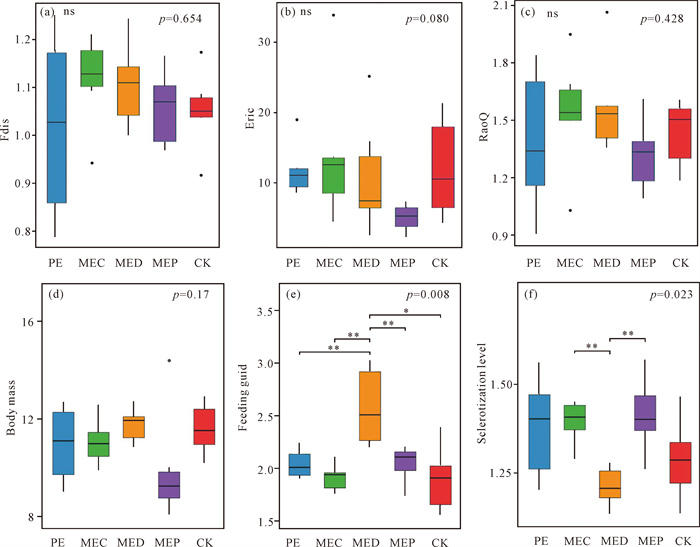
研究区各林分类型土壤螨类群落FDis、FRic和RaoQ虽然在统计学上无显著性差异(P>0.05),但其数值呈现不同变化趋势。其中,MEC土壤螨类群落的FDis最高,PE最低[图 3(a)];CK土壤螨类群落的FRic最高,MEP最低[图 3(b)];MEC土壤螨类群落的RaoQ最高,MEP最低[图 3(c)]。
|
| * and ** indicate significant differences between different forest stands at P < 0.05 and P < 0.01 levels, respectively; ns indicates no significant difference among different forest stands (P>0.05);the black dots outside the boxplots represent outliers of each group. 图 3 研究区不同林分类型土壤螨类功能多样性和功能性状分析 Fig. 3 Functional diversity and functional traits of soil mites across different forest stands in the study area |
相比其他林分,MEP土壤螨类的平均体质量最小,各林分类型土壤螨类的体质量无显著性差异[图 3(d),P>0.05]。各林分类型间土壤螨类的取食偏好与表皮骨化程度存在显著性差异(P=0.008、P=0.023),其中,MED土壤螨类取食偏好类型与其他4种林分类型差异显著[图 3(e),P<0.05]。MED与CK土壤螨类表皮骨化程度最相似,低于其他3种林分类型,且MED土壤螨类表皮骨化程度显著低于MEC和MEP[图 3(f),P<0.05]。
2.5 捕食性革螨生态类群5种林分类型捕食性革螨的MI值由高到低依次为CK (0.875)、MEC (0.667)、PE (0.655)、MEP (0.607)、MED (0.593),生态类群均为K选择型,(表 3)。
| 林分类型Stand type | MI值MI value | 选择型Selection |
| PE | 0.655 | K |
| MEC | 0.667 | K |
| MED | 0.593 | K |
| MEP | 0.607 | K |
| CK | 0.875 | K |
| All stand types | 0.676 | K |
2.6 甲螨生态类群
属数占比数据显示,5种林分类型土壤甲螨的生态类群均为O型;个体数占比数据显示,5种林分类型土壤甲螨的生态类群均为M型,其中MED的M型占比最高,达78.3%(表 4)。
| 林分类型Stand type | 属数占比/% Genus proportion/% | 生态类型Ecological type | 个体数占比/% Individual proportion/% | 生态类型Ecological type | ||||
| M群M group | P群P group | G群P group | M群M group | P群P group | G群P group | |||
| PE | 35.7 | 31.0 | 33.3 | O | 60.1 | 14.3 | 25.6 | M |
| MEC | 32.5 | 32.5 | 35.0 | O | 54.5 | 27.7 | 17.9 | M |
| MED | 31.4 | 37.1 | 31.4 | O | 78.3 | 8.5 | 13.2 | M |
| MEP | 33.3 | 36.4 | 30.3 | O | 54.5 | 20.6 | 25.0 | M |
| CK | 35.6 | 33.3 | 31.1 | O | 66.7 | 16.8 | 16.5 | M |
3 讨论 3.1 不同林分类型土壤螨类群落结构差异
本研究发现,裂甲螨属是本研究区的绝对优势属,该属主要分布于热带和亚热带地区,主要以腐烂凋落物为食[49],表皮骨化程度中等偏下[40],而表皮骨化程度低则对湿润环境较为依赖[50]。这些结果说明凋落物、温度和湿度是维持研究区土壤螨类丰度的重要因素,同时也表明裂甲螨属对桉树人工林环境有较强的适应性。裂甲螨属在不同经营措施下的数量动态,未来或可作为评估桉树林土壤微环境变化的潜在参考指标之一。
相较于纯林,混交林通常表现出更高的生物多样性,且通过物种间互补效应显著增强了生态系统功能[51]。本研究结果显示,MEC土壤螨类的H和RS高于其他林分类型,且与CK最相似(图 1);其属的组成中,广汉甲螨属为优势属,而裂甲螨属数量则低于PE (表 1)。这一结果与一项针对壳斗科树种(含红锥)凋落物分解的研究结论[29]相似。该研究发现,土壤螨类多样性在凋落物分解缓慢时更高[29],这进一步支持了栖息地异质性与资源供给是维持土壤螨类多样性的关键因子的观点[52]。过渡带也表现出较高的土壤螨类多样性和丰富度,此现象与植物多样性对土壤动物影响的相关研究结果[53-54]趋同,植物多样性高意味着能够为土壤动物提供充足、高质量的食物来源和稳定的栖息地[15-16]。而MED、MEP土壤螨类多样性和丰富度较低,这可能是因为尽管引入这两种乡土树种增加了乔木树种多样性,但是其林下植被多样性和生物量比MEC低[8, 55]。
3.2 不同林分类型土壤螨类功能性状分析相比物种多样性指标,土壤动物功能性状对环境变化的响应更能反映其所在生态系统的结构或功能改变[56-57]。本研究中,MEP土壤螨类平均体质量低于其他林分类型,表明MEP土壤螨类以小体型为主,这一现象的重要贡献者为小缝甲螨属,该属为中小体型螨类[34],且在该林分中为除裂甲螨属外的优势属(表 1)。这反映了其所在微生境可能具有特定的资源分配模式或干扰机制,较小体型往往与更快的代谢率、繁殖周期以及对资源波动的不同响应策略有关[58]。例如在华东沿海地区,自生草地与受管理城市景观绿地的土壤螨类平均体质量显著小于城市次生林地[40]。MED土壤螨类取食偏好和表皮骨化程度与其他林分类型存在较大差异[图 3:(e)、(f)]。根据文献记载,全罗甲螨属具有取食植物根部的习性[45],结合其在MED中的高度聚集性,推测植食性可能是其在该生境中的重要取食模式。该现象或因降香黄檀为固氮树种,与桉树混交后能显著提高林下植物生物量[8, 13],为全罗甲螨属提供了充足的根际食物,从而利于其在该生境中聚集。有研究表明,固氮树种的存在显著增加了杂食-捕食性线虫的丰度,并且,在固氮树种存在时进一步增加树种丰富度,会显著提高食真菌线虫的丰度[23],说明固氮树种对土壤动物具有一定调控作用。土壤螨类高度表皮骨化是一种重要的防御机制[59],但形成硬化的表皮结构需要更多时间和能量[60],MED可能通过改变资源基础来促使全罗甲螨属将更多的能量用于繁殖和摄食。
3.3 土壤螨类群落相似性分析与两大功能类群分析土壤螨类群落相似性分析是衡量不同生境土壤螨类关系的重要指标,在群落结构分析中具有重要作用[61]。相关研究表明,区域范围内,生境越相似,生物群落相似性往往越高;反之若生境类型差异较大,群落相似性通常较低[62-63]。研究区5种林分类型间土壤螨类群落相似性均属于中等相似,表明各林分类型间存在中等程度的物种共享。这可能是由于在较小的区域范围内,不同类型的人工林仍可能存在共同的环境因子和利于土壤螨类生存的空间,从而驱使物种组成趋于相似[64]。
捕食性革螨MI和甲螨生态类群分析常用于评估土壤环境受干扰情况,根据捕食性革螨的生长特点,可将其分为K选择型和r选择型,K选择型比例越高,说明环境受干扰越小,因此,MI值可作为环境变化参考因子[46-47]。研究区各林分类型捕食性革螨均为K选择型,说明研究区受干扰程度较小,其中CK的MI值(0.875)最高,说明CK土壤螨类群落组成已趋于稳定,与多样性分析结果趋于一致。人工林土壤动物0—11年为快速增长期,12—20年群落结构逐渐稳定,而后为长久稳定期[65]。这与研究区现实情况吻合:CK拥有比人工林更高的林龄且先到达稳定期。甲螨生态类群分析结果显示,其个体数在各林分类型均为M型,属数均为O型,此类型表现为群落结构较稳定。本研究中捕食性革螨MI和甲螨生态类群分析结果与贵州梵净山常绿阔叶林[66]、朝营小流域次生林[67]和喀斯特洞穴苔藓环境[62]螨类调查结果相似,进一步佐证了研究区整体土壤环境稳定、良好,受干扰程度较小。
4 结论综上,引入红锥与尾巨桉混交,增加了土壤螨类群落丰富度与功能多样性,其土壤螨类群落结构也最接近于人为干扰最少、林龄最长的次生林状态。而引入降香黄檀与尾巨桉混交,改变了土壤螨类群落功能性状结构。从群落相似性分析结果来看,各林分类型土壤螨类属的组成差异较小,大部分物种相互重叠。捕食性革螨MI和甲螨生态类群分析结果显示,研究区整体土壤环境稳定、受干扰程度低。由于人工林土壤动物群落结构会随着林龄和季节的变化而不同[65, 68],今后的研究应加强不同季节和不同林龄土壤螨类监测与多因子关联分析,以期更全面地了解桉树人工林引入乡土树种混交后土壤螨类群落结构变化及其变化机制,从而促进桉树人工林可持续经营实施。
| [1] |
中国科学院中国植物志编辑委员会. 中国植物志第五十三卷第一分册[M]. 北京: 科学出版社, 1984.
|
| [2] |
祁述雄. 中国桉树[M]. 2版. 北京: 中国林业出版社, 2002.
|
| [3] |
XIE Y J, ARNOLD R J, WU Z H, et al. Advances in eucalypt research in China[J]. Frontiers of Agricultural Science and Engineering, 2017, 4(4): 380. DOI:10.15302/J-FASE-2017171 |
| [4] |
国家林业和草原局. 中国森林资源报告(2014—2018)[M]. 北京: 中国林业出版社, 2019.
|
| [5] |
于福科, 黄新会, 王克勤, 等. 桉树人工林生态退化与恢复研究进展[J]. 中国生态农业学报, 2009, 17(2): 393-398. |
| [6] |
CAVARD X, MACDONALD S E, BERGERON Y, et al. Importance of mixedwoods for biodiversity conservation: evidence for understory plants, songbirds, soil fauna, and ectomycorrhizae in northern forests[J]. Environmental Reviews, 2011, 19: 142-161. DOI:10.1139/a11-004 |
| [7] |
SRIVASTAVA R K, YETGIN A, SRIVASTAVA S. The role of legume roots in carbon sequestration, soil health enhancement, and salinity mitigation under climate change: a comprehensive review[J]. Soil and Tillage Research, 2025, 253: 106656. DOI:10.1016/j.still.2025.106656 |
| [8] |
CHEN J W, HUANG Y J, ZHOU X G, et al. Decreased management intensity and mixed planting enhance Eucalyptus productivity through improved soil quality under eco-silviculture management in southern China[J]. Plant and Soil, 2025, 516(2): 2157-2177. DOI:10.1007/s11104-025-07853-1 |
| [9] |
许峻模, 温远光, 孙冬婧, 等. 生态营林桉树人工林林木生长动态分析[J]. 广西科学, 2023, 30(3): 494-503. DOI:10.13656/j.cnki.gxkx.20230710.008 |
| [10] |
周军. 桉树与乡土阔叶树种混交林的初期生长效应[J]. 绿色科技, 2021, 23(19): 95-96, 99. |
| [11] |
陈亮, 王家妍, 黄芳, 等. 桂南地区4种桉树林分凋落物持水性及养分特征研究[J]. 桉树科技, 2023, 40(2): 47-52. |
| [12] |
吴衍霖, 周晓果, 温远光, 等. 尾巨桉-红锥混交复合生态营林模式下尾巨桉采伐强度对林下植物多样性的影响[J]. 广西科学, 2025, 32(3): 413-425. DOI:10.13656/j.cnki.gxkx.20250310.002 |
| [13] |
HE Y Q, WEN Y G, LI K X, et al. Responses of soil multifunctionality, microbial diversity, and network complexity to tree species mixing in Eucalyptus plantations[J]. Industrial Crops and Products, 2025, 225: 120575. DOI:10.1016/j.indcrop.2025.120575 |
| [14] |
WANG Z, XU Y X, HE C, et al. Impact of native tree species introduction on soil nutrient and bacterial community in Eucalyptus plantations[J]. European Journal of Forest Research, 2023, 142(6): 1369-1383. DOI:10.1007/s10342-023-01594-5 |
| [15] |
ZHANG Y K, PENG S, CHEN X L, et al. Plant diversity increases the abundance and diversity of soil fauna: a meta-analysis[J]. Geoderma, 2022, 411: 115694. DOI:10.1016/j.geoderma.2022.115694 |
| [16] |
KORBOULEWSKY N, PEREZ G, CHAUVAT M. How tree diversity affects soil fauna diversity: a review[J]. Soil Biology and Biochemistry, 2016, 94: 94-106. DOI:10.1016/j.soilbio.2015.11.024 |
| [17] |
STORK N E. How many species of insects and other terrestrial arthropods are there on earth?[J]. Annual Review of Entomology, 2018, 63: 31-45. DOI:10.1146/annurev-ento-020117-043348 |
| [18] |
HAUER A, ZUEV A, CHATZINOTAS A, et al. Tracking assimilation of microbial biomass, leaf litter and artificially created soil organic matter by soil fauna using multi-resource stable isotope labelling[J]. European Journal of Soil Biology, 2025, 126: 103752. DOI:10.1016/j.ejsobi.2025.103752 |
| [19] |
GEORGE P B L, KEITH A M, CREER S, et al. Evaluation of mesofauna communities as soil quality indicators in a national-level monitoring programme[J]. Soil Biology and Biochemistry, 2017, 115: 537-546. DOI:10.1016/j.soilbio.2017.09.022 |
| [20] |
POTAPOV A M. Multifunctionality of belowground food webs: resource, size and spatial energy channels[J]. Biological Reviews of the Cambridge Philosophical Society, 2022, 97(4): 1691-1711. DOI:10.1111/brv.12857 |
| [21] |
FENG Y H, SCHMID B, LOREAU M, et al. Multispecies forest plantations outyield monocultures across a broad range of conditions[J]. Science, 2022, 376(6595): 865-868. DOI:10.1126/science.abm6363 |
| [22] |
BENNETT J A, KLIRONOMOS J. Climate, but not trait, effects on plant-soil feedback depend on mycorrhizal type in temperate forests[J]. Ecosphere, 2018, 9(3): e02132. DOI:10.1002/ecs2.2132 |
| [23] |
MA J H, LUAN J W, WANG H, et al. Nitrogen-fixing tree species rather than tree species diversity shape soil nematode communities in subtropical plantations[J]. Geoderma, 2023, 436: 116561. DOI:10.1016/j.geoderma.2023.116561 |
| [24] |
STEFFEN G P K, STEFFEN R B, MISSIO E L, et al. Soil macrofauna in native forests and forest monocultures in the central region of Rio Grande do sul state, Brazil[J/OL]. Environment, Development and Sustainability, 2024(2024-11-06)[2025-10-17]. https://doi.org/10.1007/s10668-024-05589-z.
|
| [25] |
LIU C L C, KUCHMA O, KRUTOVSKY K V. Mixed-species versus monocultures in plantation forestry: development, benefits, ecosystem services and perspectives for the future[J]. Global Ecology and Conservation, 2018, 15: e00419. DOI:10.1016/j.gecco.2018.e00419 |
| [26] |
中国林学会. 桉树科学发展问题调研报告[M]. 北京: 中国林业出版社, 2016.
|
| [27] |
MORALES M M, TONINI H, BEHLING M, et al. Eucalyptus carbon stock research in an integrated livestock-forestry system in Brazil[J]. Sustainability, 2023, 15(10): 7750. DOI:10.3390/su15107750 |
| [28] |
JALETA D, MBILINYI B, MAHOO H, et al. Eucalyptus expansion as relieving and provocative tree in Ethiopia[J]. Journal of Agriculture and Ecology Research International, 2016, 6(3): 1-12. |
| [29] |
KANEKO N, SALAMANCA E. Mixed leaf litter effects on decomposition rates and soil microarthropod communities in an oak-pine stand in Japan[J]. Ecological Research, 1999, 14(2): 131-138. DOI:10.1046/j.1440-1703.1999.00292.x |
| [30] |
金效华, 周志华, 袁良琛. 国家重点保护野生植物[M]. 武汉: 湖北科学技术出版社, 2023.
|
| [31] |
HUANG X M, LIU S R, YOU Y M, et al. Microbial community and associated enzymes activity influence soil carbon chemical composition in Eucalyptus urophylla plantation with mixing N2-fixing species in subtropical China[J]. Plant and Soil, 2017, 414: 199-212. DOI:10.1007/s11104-016-3117-5 |
| [32] |
王磊, 温远光, 周晓果, 等. 尾巨桉与红锥混交对林下植被和土壤性质的影响[J]. 生态环境学报, 2022, 31(7): 1340-1349. |
| [33] |
杨婷, 周晓果, 温远光, 等. 生态营林对桉树人工林土壤有机碳组分及酶活性的影响[J]. 广西科学, 2025, 32(3): 426-438. DOI:10.13656/j.cnki.gxkx.20250310.003 |
| [34] |
尹文英, 沈韫芬, 宋大祥, 等. 中国土壤动物检索图鉴[M]. 北京: 科学出版社, 1998.
|
| [35] |
KRANTZ G W, WALTER D E. A manual of acarology[M]. 3rd ed. Lubbock, USA: Texas Tech University Press, 2009.
|
| [36] |
李隆术. 蜱螨学[M]. 重庆: 重庆出版社, 1988.
|
| [37] |
YEATES G W, BONGERS T. Nematode diversity in agroecosystems[M]//PAOLETTI M G. Invertebrate biodiversity as bioindicators of sustainable landscapes: practical use of invertebrates to assess sustainable land use. Amsterdam: Elsevier, 1999: 113-135.
|
| [38] |
JIAO S, CHU H Y, ZHANG B G, et al. Linking soil fungi to bacterial community assembly in arid ecosystems[J]. iMeta, 2022, 1(1): e2. DOI:10.1002/imt2.2 |
| [39] |
傅荣恕, 尹文英. 伏牛山地区土壤动物群落的初步研究[J]. 动物学研究, 1999, 20(5): 396-398. |
| [40] |
PAN S F, LIANG J, WU H B, et al. Effect of urban greening and afforestation on soil microarthropod communities in coastal reclaimed land: insights from functional traits[J]. Applied Soil Ecology, 2022, 173: 104391. DOI:10.1016/j.apsoil.2022.104391 |
| [41] |
NEWTON J S, PROCTOR H C. A fresh look at weight-estimation models for soil mites (Acari)[J]. International Journal of Acarology, 2013, 39(1): 72-85. DOI:10.1080/01647954.2012.744351 |
| [42] |
KLARNER B, MARAUN M, SCHEU S. Trophic diversity and niche partitioning in a species rich predator guild-natural variations in stable isotope ratios (13C/12C, 15N/14N) of mesostigmatid mites (Acari, Mesostigmata) from Central European beech forests[J]. Soil Biology and Biochemistry, 2013, 57: 327-333. DOI:10.1016/j.soilbio.2012.08.013 |
| [43] |
SCHNEIDER K, MIGGE S, NORTON R A, et al. Trophic niche differentiation in soil microarthropods (Oribatida, Acari): evidence from stable isotope ratios (15N/14N)[J]. Soil Biology and Biochemistry, 2004, 36(11): 1769-1774. DOI:10.1016/j.soilbio.2004.04.033 |
| [44] |
MARAUN M, THOMAS T, FAST E, et al. New perspectives on soil animal trophic ecology through the lens of C and N stable isotope ratios of oribatid mites[J]. Soil Biology and Biochemistry, 2023, 177: 108890. DOI:10.1016/j.soilbio.2022.108890 |
| [45] |
EVANS C O, SHEALS J G, MACFARLANE D. The terrestrial Acari of the British Isles: an introduction to their morphology, biology and classification[M]. London: British Museum, 1961.
|
| [46] |
RUF A. A maturity index for predatory soil mites (Mesostigmata: Gamasina) as an indicator of environmental impacts of pollution on forest soils[J]. Applied Soil Ecology, 1998, 9(1/2/3): 447-452. |
| [47] |
AOKI J I. Analysis of oribatid communities by relative abundance in the species and individual numbers of the three major groups (MGP-analysis)[J]. Bulletin of Institue of Environment Science and Technology, Yokohama National University, 1983, 10: 171-176. |
| [48] |
郑祥, 鲍毅新, 孔军苗, 等. 金华北山阔叶林大型土壤动物群落的初步研究[J]. 土壤, 2005, 37(5): 545-550. |
| [49] |
NORTON R A. Systematic relationships of Lohmanniidae (Acari: Oribatida)[M]//Trends in Acarology: proceedings of the 12th international congress. Dordrecht: Springer Netherlands, 2010: 9-16.
|
| [50] |
YOSHIKAWA M. The critical equilibrium activity (minimum humidity for survival) and water loss kinetics in Dermatophagoides microceras[J]. Medical Entomology and Zoology, 1979, 30(3): 271-276. DOI:10.7601/mez.30.271 |
| [51] |
LI Q C, LIU Z L, JIN G Z. Mixed forests provide higher levels of growth and yield than monocultures across a broad range of conditions[J]. Forest Ecology and Management, 2024, 566: 122083. DOI:10.1016/j.foreco.2024.122083 |
| [52] |
HANSEN R A. Effects of habitat complexity and composition on a diverse litter microarthropod assemblage[J]. Ecology, 2000, 81(4): 1120-1132. DOI:10.1890/0012-9658(2000)081[1120:EOHCAC]2.0.CO;2 |
| [53] |
WU W J, KUANG L H, LI Y, et al. Faster recovery of soil biodiversity in native species mixture than in Eucalyptus monoculture after 60 years afforestation in tropical degraded coastal terraces[J]. Global Change Biology, 2021, 27(20): 5329-5340. DOI:10.1111/gcb.15774 |
| [54] |
POTAPOV A M, DRESCHER J, DARRAS K, et al. Rainforest transformation reallocates energy from green to brown food webs[J]. Nature, 2024, 627(8002): 116-122. DOI:10.1038/s41586-024-07083-y |
| [55] |
温远光, 周晓果, 朱宏光. 桉树生态营林理论、技术与实践[M]. 北京: 科学出版社, 2020.
|
| [56] |
孙新, 谢致敬, 乔志宏, 等. 基于功能性状的土壤动物群落生态学研究进展[J]. 应用生态学报, 2024, 35(4): 1150-1158. |
| [57] |
LU J Z, BLUHM C, FOLTRAN E, et al. Functional traits in soil-living oribatid mites unveil trophic reorganization in belowground communities by introduced tree species[J]. Geoderma, 2024, 448: 116947. DOI:10.1016/j.geoderma.2024.116947 |
| [58] |
WHITE E P, MORGAN ERNEST S K, KERKHOFF A J, et al. Relationships between body size and abundance in ecology[J]. Trends in Ecology & Evolution, 2007, 22(6): 323-330. |
| [59] |
BRÜCKNER A, WEHNER K, NEIS M, et al. Attack and defense in a gamasid-oribatid mite predator-prey experiment-sclerotization outperforms chemical repellency[J]. Acarologia, 2016, 56(4): 451-461. DOI:10.1051/acarologia/20164135 |
| [60] |
NORTON R A. Evolutionary aspects of oribatid mite life histories and consequences for the origin of the astigmata[M]//HOUCK M A. Mites. Boston, MA: Springer, 1994: 99-135.
|
| [61] |
马宏彬, 刘惠清. 拉萨河流域不同土地利用方式下土壤动物的群落特征[J]. 东北师大学报(自然科学版), 2012, 44(2): 84-90. |
| [62] |
GONG T, YIN X M, LIU W J, et al. Differences of oribatid mite community and trophic structure between karst caves and surface different moss habitats[J]. PLoS One, 2023, 18(8): e0290144. DOI:10.1371/journal.pone.0290144 |
| [63] |
排孜丽耶·合力力, 吾玛尔·阿布力孜, 阿丽亚·司地克. 新疆天山森林公园土壤螨类群落多样性与环境因子的相关性[J]. 生态学报, 2019, 39(5): 1639-1652. |
| [64] |
ERDMANN G, SCHEU S, MARAUN M. Regional factors rather than forest type drive the community structure of soil living oribatid mites (Acari, Oribatida)[J]. Experimental and Applied Acarology, 2012, 57(2): 157-169. DOI:10.1007/s10493-012-9546-9 |
| [65] |
PENG S L, LIU J, LU H F. Characteristics and rolle of Acacia auriculiformis on vegetation restoration in lower subtropics of China[J]. Journal of Tropical Forest Science, 2005, 17(4): 508-525. |
| [66] |
林丹丹, 陈浒, 陈海, 等. 梵净山常绿阔叶林土壤螨类群落结构[J]. 应用与环境生物学报, 2018, 24(5): 1185-1194. |
| [67] |
陈浒, 金道超, 张燕. 喀斯特小流域栓皮栎林土壤螨类群落结构特征[J]. 应用生态学报, 2018, 29(5): 1667-1676. |
| [68] |
CHEN Y M, WANG M Q, PAN X, et al. Season affects soil oribatid mite communities more than tree diversity in subtropical forests[J]. Geoderma, 2024, 443: 116826. DOI:10.1016/j.geoderma.2024.116826 |