


2. 南方海洋科学与工程广东省实验室(广州), 广东广州 511458
2. Southern Marine Science and Engineering Guangdong Laboratory, Guangzhou, Guangdong, 511458, China
珊瑚礁生态系统是地球上生物多样性和生产力较高的生态系统之一,其生态功能的维持高度依赖于造礁石珊瑚这一关键框架生物[1]。然而,气候变暖、极端降水、海洋酸化和水体富营养化等环境胁迫会造成珊瑚宿主与共生虫黄藻的共生关系破裂,使得珊瑚将共生虫黄藻排出细胞外并致使共生虫黄藻的光合色素降解,最终导致珊瑚白化甚至死亡[2]。当响应环境胁迫时,珊瑚在其分子、细胞及生理生化水平都会产生一系列反应,是其应对环境胁迫的第一道防线。珊瑚及其共生虫黄藻都能通过基因表达的改变来重新配置代谢通路,以维持必需的新陈代谢并通过建立新的稳态来适应环境变化[3]。随着全球变暖不断加剧,珊瑚白化事件的频率和强度也在不断上升,但生态调查同时也发现部分珊瑚种群正在逐步建立环境适应性,因此珊瑚环境响应的内在分子机制有待深入研究。
近年来,生物信息技术快速发展推动了以转录组为首的组学技术在珊瑚研究中的广泛应用,这从根本上改变了珊瑚环境适应性机制的研究范式[4-5]。转录组学技术能够识别珊瑚宿主和共生虫黄藻,为研究珊瑚与虫黄藻共生的内在分子机制提供了更为有效的方法[6]。作为在RNA水平上解析转录组图谱的研究技术,转录组学通过全面揭示生物体的基因表达情况,以阐述细胞、组织或器官在特定条件下的生命活动规律。目前,转录组学技术已被广泛应用于探究珊瑚共生功能体在高温、海水酸化、低盐胁迫、海水富营养化、污染物暴露等不同环境压力下的响应机制,为阐明珊瑚对环境胁迫的适应性机制提供了重要技术支撑[7]。本综述对国内外转录组学在造礁石珊瑚环境适应性中的应用进行了总结,深入分析了当前研究存在的局限性,并对未来相关的研究方向进行了展望。通过整合现有的研究成果,本文旨在为深入理解不同环境胁迫下珊瑚共生功能体环境适应性的分子机制及共生互作协同效应提供理论参考,同时也为珊瑚礁生态系统的保护与修复提供科学依据。
1 转录组学技术分类与发展转录组是特定组织或细胞在某一发育阶段或功能状态下转录出来的全部RNA的集合[8]。作为一门从整体水平上研究细胞中基因转录情况及转录调控规律的学科,转录组学与静态稳定的基因组有所不同,其能够反映研究对象的动态变化。这种动态特性体现在同一基因在不同环境、不同时期和不同组分中的表达差异上。转录组学研究技术主要分为两大类:一类是杂交转录组学,以杂交图谱荧光信号的强弱来判断基因表达的丰度,包括微阵列(Microarray)技术、基因芯片(Gene chip)技术;另一类是测序转录组学,该技术通过组装、拼接得到相关序列,从而快速获取转录本相关信息,主要包括表达序列标签(Expressed Sequence Tags,EST)技术、基因表达序列分析(Serrial Analysis of Gene Expression,SAGE)、大规模平行测序(Massively parallel sequencing)技术、RNA Sequence (RNA-Seq)技术、单细胞转录组测序(Single cell transcriptome sequencing,scRNA-seq)技术等。
早期的转录组测序技术,如Microarray、Gene chip、EST等,虽然可以检测出基因的表达丰度,但是受限于物种基因组信息,难以应用到还未完成全基因组测序或者基因注释信息不完善的物种上。随着测序技术的革新,RNA-Seq技术凭借其不依赖于预先设计的探针或已知序列信息的特点,逐渐成为目前主流的转录组测序技术。该技术具有通量高、准确性高、检测范围广、成本低等优势,可以应用于基因组图谱尚未完成组装的物种上[9]。在此基础上,scRNA-seq技术作为新兴技术,能够解析组织细胞之间的基因表达异质性。该技术以单个细胞为检测单位,可以获得单个细胞的转录组信息,为揭示不同类型细胞在发育过程中的功能分化以及细胞间的调控网络提供了重要工具[10]。
目前,基于Illumina的下一代测序是主流的转录组测序技术。然而,由于读长较短,基于算法组装的全长转录本的质量相对较低。第三代全长转录本测序(TGS)的出现弥补了这一不足,其超长读长的特性显著提升了全长转录本组装的质量。转录组学技术的优缺点比较分析如表 1所示。
| 技术 Technology |
优点 Advantage |
缺点 Disadvantage |
| Microarray | High throughput and reliability | Only detects sequences targeted by hybridization probes (fails to identify new species); exhibits cross-hybridization, non-specific hybridization, and limited detection efficiency of individual probes |
| Gene chip | Accurate detection of highly expressed genes; high throughput, miniaturization, automation, low cost, and anti-contamination | Unable to detect low-abundance genes (limited by gene copy number); limited database data potentially resulting in annotation errors |
| Expressed Sequence Tags | Relatively low cost and technical threshold; prior to 2003, the primary and most efficient method for rapid discovery and identification of unknown genes | Short length without complete expression sequences; low-abundance expressed genes difficult to acquire; high error rate; identical PCR product sizes in cDNA and genomic templates (due to intron absence); poor conservation of 3′UTR sequences, easily distinguishing single genes from closely related homologous gene families |
| RNA-Seq | High throughput, resolution, and sensitivity; not limited by prior knowledge; enables differentiation of symbiont components | Fails to reveal inter-individual cellular expression heterogeneity |
| Single cell transcriptome sequencing | High sensitivity, accuracy, and specificity; high-quality high-throughput sequencing achievable with minimal sample input; avoids false-negative results from mixed cell populations; identifies rare cell subsets undetectable by bulk cell sequencing | Incompatible with high-throughput sample processing; challenging to capture full transcripts, entire transcriptomes, and full-length transcripts; only analyzes poly(A)-tailed mRNA [reliant on poly(T) primers for single-cell cDNA amplification]; stricter sample quality requirements; unable to detect most mRNA longer than 3 kb |
| Third-generation full-length transcriptome sequencing | Error correction via repeated sequencing; ultra-long read length; no requirement for template amplification; short runtime; direct detection of epigenetic modification sites and full-length transcripts | Relatively low sequencing accuracy; relies on polymerases and exonucleases with inadequate activity and stability; insufficient DNA extensibility prone to dimer formation |
2 环境胁迫下的珊瑚共生功能体转录组学研究
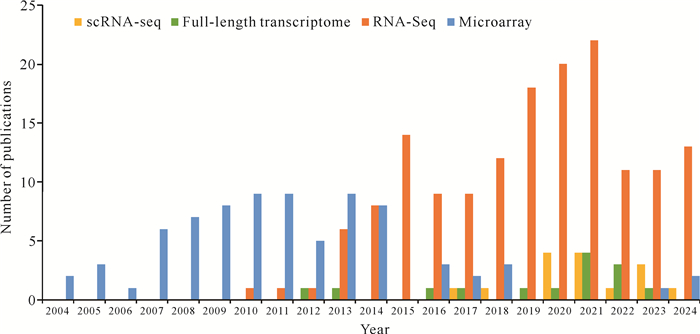
珊瑚共生功能体由珊瑚宿主、共生虫黄藻及其他微生物共同组成,珊瑚宿主为共生虫黄藻提供生存场所和代谢产物,同时也依靠共生虫黄藻通过光合作用产生的光合产物(包括葡萄糖、甘油和氨基酸)易位来满足自身的能量需求。这种互利共生关系的稳定性对珊瑚共生功能体健康的维持至关重要。作为典型的共生功能体,造礁石珊瑚对环境胁迫的响应机制涉及多基因调控网络、多信号转导途径、多代谢通路以及复杂的共生互作机制[11]。因此,在利用转录组学研究珊瑚共生功能体环境适应性时,必须对珊瑚宿主和共生虫黄藻共同进行分析,以全面解析二者在环境压力下的基因表达变化情况及其相互作用机制。近年来,基于转录组学的珊瑚研究取得了一定的进展,揭示了一系列与环境适应性相关的重要基因和代谢通路。为深入了解珊瑚共生功能体转录组学研究,以“coral”“Microarray”“scRNA-seq”“Full-length transcriptome”“RNA-Seq”“Transcriptome”为检索关键词,并运用计算机检索语言将各个检索词进行联结,以美国科学信息研究所(Institute for Scientific Information, ISI)旗下的Web of Science核心合集[具体采用了其科学引文索引扩展版(SCIE)数据库]、中国知网(China National Knowledge Infrastructure, CNKI)数据库中SCI来源期刊、EI来源期刊、中文核心期刊、硕博论文为来源数据,检索2004-2024年珊瑚转录组学研究相关文献。结果发现,随着转录组学技术的更新换代,RNA-Seq技术已成为当前珊瑚研究的主流技术手段(图 1)。基于此,本文主要综述珊瑚共生功能体在不同环境胁迫下采用RNA-Seq技术的转录组学研究,以期为深入理解造礁石珊瑚环境适应性机制提供新的见解。
|
| 图 1 珊瑚转录组学研究的历年发文量统计 Fig. 1 Annual publication statistics in coral transcriptomic research |
2.1 高温胁迫
随着全球变暖的加剧,海表温度的快速上升导致珊瑚热白化事件的频率和强度显著增加[12],高温已经成为引发珊瑚白化的最主要环境胁迫因素。为减轻热应激对细胞造成的损伤,珊瑚细胞内部发生了一系列反应,比如氧化还原调节、分子伴侣表达量上调、内质网应激和免疫反应等。在急性高温胁迫条件下,珊瑚对热应激产生巨大而快速的转录反应[13-15]。热应激首先广泛影响蛋白质加工、细胞生长周期和代谢,而后期的珊瑚白化反应则与RNA转运、细胞外基质、珊瑚钙化,以及DNA复制、修复活性相关。在珊瑚热白化的过程中,转录调控、蛋白质合成、细胞转运、细胞骨架重排和氧化还原稳态等这些与重要细胞功能和活动相关的通路显著表达。
在珊瑚共生功能体对高温胁迫的转录响应研究中,热休克蛋白(HSP)的编码基因是研究最为深入的基因。研究发现,热应激下珊瑚宿主细胞内大量热休克蛋白基因显著上调,表明其在热应激响应中发挥着关键作用[16-18]。Traylor-Knowles等[19]研究表明,在急性高温胁迫期间,风信子鹿角珊瑚(Acropora hyacinthus)在20 min内上调与热应激相关的特定基因的表达,在5 h内约20%的基因表达会显著上调。另外,珊瑚广义应激反应首先涉及转座子和转录因子的短期反应;然后启动下游过程[19](该过程得到了与热应激相关共表达基因网络的支持[20],并且该过程还伴随着HSP的短期上调和下调[19, 21]);最后,转录组反应调控代谢过程的下调,限制珊瑚代谢、生长、细胞分裂、复制和蛋白质翻译相关的基因表达。热休克蛋白和转录因子在急性胁迫早期上调,表明热休克蛋白调控着热白化的整个过程。
经历热白化事件的珊瑚具有一定的自我恢复能力。Zhang等[22]通过转录组分析发现,自然热白化的十字牡丹珊瑚(Pavona decussata)在自我恢复过程中,与有丝分裂、DNA复制和重组相关的通路显著富集,这有助于珊瑚组织修复和能量代谢恢复。Li等[23]在实验室条件下探究了鹿角杯形珊瑚(Pocillopora damicornis)共生功能体对逐渐升温的转录响应,结果发现随着温度的升高,鹿角杯形珊瑚对温度升高的反应比共生虫黄藻更快。另外,蛋白组学研究结果进一步验证了转录组学的研究结果。Petrou等[24]发现,与对照组相比,高温胁迫下的多孔鹿角珊瑚(Acropora millepora)中参与氧化应激和蛋白质水解的相关蛋白酶显著增加,而共生虫黄藻中与光合作用、能量代谢相关的蛋白酶减少。上述结果均表明珊瑚正在通过相关变化来抵抗高温胁迫。
不同形状和种类珊瑚的热耐受性存在显著差异。块状珊瑚通常比片状、枝状珊瑚具有更高的热耐受性[19];而相对棕色丛生盔形珊瑚(Galaxea fascicularis)来说,绿色丛生盔形珊瑚具有更高的绿色荧光强度和GFP样蛋白编码基因转录水平,因而具有更高的耐热能力[25]。此外,共生虫黄藻的类型也会显著影响宿主的热耐受性。Cunning等[26]通过控制实验发现,与D型虫黄藻共生的Montastraea cavernosa,其与核糖体结构、翻译活性相关的基因显著上调,生长更快,并且在短期热应激下表现出更强的热耐受性。
为提高珊瑚共生功能体对高温的耐受性,研究人员开展了珊瑚热驯化研究。Yu等[27]对霜鹿角珊瑚(Acropora pruinosa)进行热驯化后发现,珊瑚宿主中与代谢相关的基因,特别是氮代谢通路相关基因的表达显著下调,表明热驯化后的珊瑚可能通过降低新陈代谢水平来实现自我保护。因此,热驯化改变了珊瑚共生功能体的能量代谢途径,促进了营养物质从共生虫黄藻向珊瑚宿主转移,进而增强了其热适应性。
2.2 强光胁迫大规模珊瑚白化事件不仅与持续高温有关,而且与太阳辐射强度、海面平静状态和海水透明度等其他自然环境因素共同作用有关。强光胁迫主要对珊瑚共生虫黄藻的光合系统和免疫系统造成损伤,而珊瑚宿主能够通过调节荧光蛋白和非荧光色蛋白基因的表达来减轻强光的不利影响。
朱乐等[28]在26 ℃恒定温度下进行单因素光胁迫实验,发现强光胁迫导致短指软珊瑚(Sinularia sp.)共生虫黄藻密度骤降98.69%,且多样性显著丧失、光合功能严重受损;与此同时,珊瑚宿主通过上调免疫通路(如FcγR吞噬作用、RIG-I样受体通路)基因和异养营养(蛋白消化吸收)相关基因,并借助共生细菌(如Endozoicomonas sp.)重组维持生存,证实宿主对强光的耐受性更强。而Jia等[29]研究同样发现,在排除高温干扰的条件下,强光胁迫不仅显著影响共生虫黄藻的光合系统功能,而且可对其免疫能力产生负面影响,但丛生盔形珊瑚宿主对强光的耐受性相对更强。然而,在自然海域环境中,持续的高温往往也伴随着强光的辐射[30],因此二者的协同作用可能加剧对珊瑚共生功能体的胁迫效应。
共生虫黄藻的类型显著影响珊瑚对强光和高温的耐受性。Yuyama等[31]的研究发现,与D型虫黄藻共生的单独鹿角珊瑚(Acropora solitaryensis)表现出对强光和高温更强的耐受性。转录组分析显示,D型虫黄藻中与光合作用相关的基因表达显著上调,而与离子转运、蛋白质折叠相关的基因表达显著下调,这种独特的基因表达模式可能是D型虫黄藻增强珊瑚功能共生体环境耐受性的重要机制[31]。为应对强光胁迫,珊瑚宿主也进化出有效的保护机制。在强光胁迫下,珊瑚体内荧光蛋白和非荧光色蛋白基因转录表达显著上调,这些蛋白能够吸收紫外线辐射,减少光损伤,从而增强珊瑚功能共生功能体对太阳辐射的抵抗能力[31]。这种光保护机制与珊瑚宿主的转录调控网络密切相关,是珊瑚适应强光环境的重要策略[31]。
2.3 海水酸化胁迫大气中CO2浓度的快速升高不仅加速了全球变暖,而且导致海水pH值下降,引起海水酸化现象,进而对珊瑚礁生态系统造成严重威胁。当有海水温度升高、重金属离子超标等其他环境因子协同作用时,海水酸化对生物体的影响将更加显著[32-33]。
海水酸化主要影响珊瑚钙化作用、代谢、细胞酸碱调节、应激响应等[34],而最直接的影响是与碳酸酐酶(CA)分泌相关基因的表达。Griffiths等[35]发现来自不同低pH值环境下的Balanophyllia elegans转录响应存在差异。急性应激初期通常会引起基因的快速显著表达,从而恢复珊瑚体内平衡;而长期的慢性应激暴露意味着适应已经发生,相关基因的表达仅限于维持所必需的稳态。长期处于低pH值环境中的珊瑚具有更强的离子转运能力以适应环境并维持胞内pH稳态和钙化,而没有经历过低pH值环境驯化的珊瑚,在低pH胁迫下其细胞应激反应相关基因表达下调[35]。Kenkel等[36]对长期适应低pH值自然环境的多孔鹿角珊瑚及共生虫黄藻进行转录组分析后发现,珊瑚宿主参与脂肪酸代谢相关的基因表达发生变化,共生虫黄藻细胞生长分裂增强,共生功能体转录反应复杂并对共生体之间相互作用产生影响。
不同种类的珊瑚对海水酸化的转录响应存在显著差异。Radice等[37]通过将不同种类珊瑚移植到天然低pH值的野外环境中发现,耐受性低的Siderastrea siderea表现出更为固定的转录响应模式,而耐受性较高的两种滨珊瑚(Porites astreoides和Porites porites)则表现出更强的转录可塑性。这种物种特异性响应机制为理解珊瑚对海洋酸化的适应策略提供了重要的资料。
2.4 低盐胁迫随着气候变暖,全球水循环加剧,导致极端降水事件的频率和强度不断增加。降水的变化对河口区域的珊瑚群落产生了极大影响——由于降水量增加和入海径流量增大,该区域的珊瑚更易受到低盐胁迫,进而出现白化现象。例如,香港的亚热带珊瑚群落在2014年和2022年都因夏季极端强降水导致珊瑚低盐白化事件的发生[38-40]。2022年雨季,珠江三角洲地区强降雨事件增多,年降水量较2021年多33.3%,较常年多12.9%,而珠江年入海径流量较常年偏多11.0%,这使得珠江冲淡水作用加剧,该海域底层海水盐度骤降至26.975,导致该海域的珊瑚群落发生严重的低盐白化事件[41]。
Chen等[41]研究表明,鹿角杯形珊瑚对低盐胁迫的响应模式因胁迫持续时间而异:在急性低盐胁迫下,与离子转运、细胞渗透压调节相关的基因显著上调;而在长期低盐驯化过程中,具有低盐耐受性的鹿角杯形珊瑚则表现出与代谢相关基因的显著下调。Aguilar等[42]通过低盐胁迫实验揭示了多孔鹿角珊瑚在急性低盐胁迫下的转录组动态响应特征,发现与急性低盐胁迫1 h的珊瑚相比,经历24 h低盐胁迫的珊瑚中与蛋白质稳态、氨基酸和氮代谢相关的基因表达显著上调;同时,多孔鹿角珊瑚中许多与离子或有机分子转运相关的基因表达改变,特别是参与甘氨酸甜菜碱分解代谢的基因,其转录水平显著升高。珊瑚在低盐环境下的适应机制主要涉及细胞渗透压的调节,其对盐度波动的响应主要通过调节相容性有机渗透压物质(如甘油、游离氨基酸和多元醇)来实现[43-45]。除此之外,Chen等[41]的研究揭示了不同低盐耐受性鹿角杯形珊瑚个体的转录组差异:低盐耐受性低的珊瑚个体受到了更严重的免疫损伤,其与免疫防御、细胞应激相关的基因显著上调;而耐受性更高的珊瑚个体中与糖酵解/糖异生相关的代谢基因显著下调。值得注意的是,在这些高耐受性珊瑚的共生虫黄藻中,与氧化磷酸化相关的基因显著上调,这可能是共生功能体补充能量需求以避免白化发生的重要机制之一[41]。
2.5 营养盐胁迫海水营养富集(如溶解氮的增加)可能对造礁石珊瑚产生负面影响,导致珊瑚白化发生率上升。然而,营养盐胁迫下珊瑚共生功能体的响应机制复杂,营养盐胁迫对珊瑚的影响具有两面性。
Rosic等[46]通过研究粗糙鹿角珊瑚(Acropora aspera)在铵态氮胁迫下的早期转录变化发现,与卵巢减数分裂相关的通路和参与分子摄取的内吞通路显著富集,这表明营养盐胁迫影响珊瑚的繁殖、降低酶活性、促进分解代谢并减少离子转运;另外,共生虫黄藻核酮糖二磷酸羧化酶和胡萝卜素、叶绿素(a、b、c)结合蛋白基因的表达上调,光合作用能力增强。氮含量的增加会对珊瑚的生长和共生体密度产生积极影响,但与此同时也会带来消极影响,如宿主释放藻类的百分比增加。高温应激会导致珊瑚氮含量增加,正如周榆鹏等[47]研究所示,高温胁迫下风信子鹿角珊瑚通过显著提升谷氨酰胺合成酶(GS)的活性来强化其氨氮同化能力,从而利于其共生藻密度及叶绿素含量的维持;相较之下,美丽鹿角珊瑚(Acropora muricata)在34 ℃时GS活性显著降低,导致其共生藻流失加速并呈现白化趋势。Yuan等[48]的研究结果表明,高浓度铵离子胁迫显著抑制了鹿角杯形珊瑚的核酸代谢和基因表达,调控了G蛋白偶联受体蛋白信号通路,使转录发生重构;同时,还诱导和调控了珊瑚细胞的凋亡和死亡。
铵态氮一方面对珊瑚造成了营养盐胁迫,另一方面又可能缓解珊瑚热应激反应。Zhou等[49]研究发现,铵态氮含量的升高对高温胁迫下的鹿角杯形珊瑚有积极的影响,不仅可以抑制热应激对珊瑚细胞凋亡和死亡的诱导,而且会抑制珊瑚细胞发育、分化等生理过程,减少能量消耗,将更多能量供给珊瑚必需的生命活动,从而提高珊瑚的恢复力。
2.6 缺氧胁迫海洋变暖和海水富营养化使海水中的溶解氧含量不断降低,这种缺氧环境会导致珊瑚白化甚至死亡。据预测,到2100年全球海洋的脱氧率将达到7%[50]。随着缺氧事件和缺氧水域的不断增加,缺氧对珊瑚礁生态系统的潜在威胁日益凸显[51]。缺氧胁迫会激活珊瑚缺氧反应系统(HIF-HRS),导致其关键基因HIFα和HSP90的表达发生变化,进而影响珊瑚细胞内稳态、离子转运、细胞自噬以及脂质吸收等重要生理生化过程。
Alderdice等[52]通过RNA-Seq分析证实,细枝鹿角珊瑚(Acropora tenuis)具有与其他后生动物同源的、由完整活性缺氧诱导因子(HIF)介导的缺氧反应系统。这一系统是珊瑚应对缺氧胁迫的关键基因网络,其中关键基因HIFα的表达上调可能有助于改变珊瑚的白化敏感性[53]。此外,HSP70和HSP90基因在提高珊瑚低氧胁迫耐受性中也发挥了重要作用,特别是HSP90的表达,它能够调控珊瑚HIF-HRS在缺氧胁迫下的代谢适应能力[53]。Alderdice等[52]研究还发现,具有更强低氧耐受性的细枝鹿角珊瑚往往表现出更高效的HIF-HRS,这些珊瑚通过维持更高的HIFα和HIF依赖性HSP90表达水平,能够快速协调O2通过钾离子通道,抑制线粒体有氧活性并激活线粒体自噬以清除功能障碍的细胞器;同时,增强蛋白质稳态和脂质摄取能力;最终通过精细调控细胞周期与死亡,决定细胞的命运走向。另外,缺氧胁迫也会降低鹿角珊瑚(Acropora sp.)白化的温度阈值,高温和脱氧共同作用导致的过度氧化应激可能会干扰HIF-HRS信号传导、加剧光损伤,并使珊瑚免疫系统受损,进而使珊瑚更易发生白化[54]。
2.7 污染物胁迫人类活动导致的化学污染物长期联合胁迫对珊瑚健康构成了严重威胁。污染物胁迫主要通过毒理效应影响珊瑚,在急性污染物胁迫下,珊瑚中与细胞应激相关的基因显著上调。
重金属、多环芳烃和农药残留是影响全球珊瑚礁生态系统健康的三大传统化学污染物。农业径流、城市及工业活动是重金属进入珊瑚礁生态系统的主要途径。Schwarz等[55]研究发现,在30 μg/L铜环境下暴露48 h的Montastraea franksi细胞出现了明显的DNA损伤和氧化应激反应。在急性镉胁迫下,鹿角杯形珊瑚中与蛋白质修饰、错误蛋白重折叠、内质网应激和细胞凋亡相关的基因表达显著上调,而与大分子代谢过程相关的基因表达显著下调,这种基因表达的正向调节有助于维持珊瑚共生体的平衡并提高其适应性[56]。多环芳烃主要通过石油烃类的燃烧和海上溢油进入海洋,并对珊瑚健康造成显著危害。在Liu等[57]的研究中,多环芳烃通过影响新陈代谢、抗氧化和解毒过程,对鹿角杯形珊瑚及其藻类共生体产生缓慢但持久的影响,但珊瑚可以通过神经内分泌调节来应对多环芳烃的胁迫。此外,除草剂、杀虫剂等残留农药通过地表径流和地下渗透进入河流,并最终汇入海洋,从而影响珊瑚健康。Zhou等[58]对暴露于草铵膦和草甘膦的鹿角杯形珊瑚进行转录组分析,发现草铵膦抑制了珊瑚的谷氨酰胺代谢,干扰了其应激反应、免疫调节和共生虫黄藻细胞生长周期;草甘膦则扰乱了珊瑚钙化、减数分裂和共生体营养物质输出。此外,除草剂扑草净严重影响虫黄藻的光合作用,破坏丛生盔形珊瑚共生虫黄藻的光系统修复机制,并且加剧高温对珊瑚关键能量和营养代谢通路的不利影响,最终导致珊瑚和虫黄藻共生关系破裂[59]。
与传统污染物相比,新兴污染物对珊瑚礁生态系统的影响也日益受到关注。微塑料作为一种新兴污染物,通过溪流、表层土壤渗透、降水以及工业生活废水排放进入海洋,其在海洋生态系统中的移动与累积对珊瑚造成了新的胁迫,特别是微塑料可能携带大量病原体,可破坏珊瑚-虫黄藻的共生关系[60]。微塑料在珊瑚体内的积累会导致珊瑚组织缺陷、免疫系统受损、生长发育迟缓甚至白化。在急性微塑料胁迫下,鹿角杯形珊瑚发生应激反应,并通过JNK和ERK信号通路抑制其解毒和免疫系统[61]。另外,在微塑料胁迫下,虫黄藻中与解毒活性、营养吸收和光合作用相关的基因表达显著下调,而与氧化应激、离子转运和细胞凋亡相关的基因表达显著上调,这直接影响了珊瑚与虫黄藻共生关系的稳定性[62-63]。此外,随着滨海旅游业的快速发展,防晒霜污染问题日益凸显。Danovaro等[64]研究表明,即使在极低的浓度水平下,防晒霜也可能引发鹿角珊瑚病毒感染,导致珊瑚白化。然而,Ishibashi等[65]发现,防晒霜中常见的成分benzophenone-3 (BP-3)对细枝鹿角珊瑚及其共生虫黄藻的毒性作用有限,这一发现为评估防晒霜对珊瑚的影响提供了新的视角。
2.8 疾病胁迫气候变化带来的环境压力正在改变与珊瑚相关的微生物群落的组成,导致有益微生物向病原体转化,进而引起珊瑚白化和疾病暴发[66]。珊瑚疾病是珊瑚宿主、病原体和环境相互作用的结果[67]。在应对病原体入侵时,珊瑚的免疫反应表现出显著的转录变化。Silva-Lima等[68]研究表明,受白色瘟疫病影响的Mussismilia braziliensis的免疫系统和细胞防御相关通路显著下调,而自噬和细胞黏附相关转录本的下调表明患病珊瑚宿主防御能力耗尽,无法有效抵御病原体的入侵而感染白化。Anderson等[69]发现,受加勒比黄带病影响的Orbicella faveolata通过Wnt蛋白表达和Notch信号传导进行先天免疫调节,展现了珊瑚对疾病的不同防御策略。
珊瑚免疫系统的信号通路归纳为4个层次:模式识别受体的病原体感应、下游信号级联、炎症细胞因子表达的激活、一系列生存或死亡响应机制的启动[70]。珊瑚对疾病的免疫反应通常以炎症为特征,涉及多种复杂的分子机制。这些机制包括抗菌肽和活性氧的产生、抗氧化剂的生成、吞噬细胞向感染部位的迁移,以及黑色素的积累[71-72]。
不同种类珊瑚对病原体的耐受性存在显著差异。Wang等[73]研究发现在溶珊瑚弧菌(Vibrio coralliilyticus)胁迫下,海孔角蜂巢珊瑚(Favites halicora)比鹿角杯形珊瑚呈现出更高的免疫相关基因转录可塑性。其中,海孔角蜂巢珊瑚中参与细胞凋亡途径的基因表达上调,而鹿角杯形珊瑚中核苷酸切除修复和碱基切除修复通路显著富集。He等[74]研究发现,强壮鹿角珊瑚(Acropora valida)通过上调能量代谢途径和先天免疫反应来应对弧菌胁迫,同时抑制与细胞生长代谢相关基因的表达和细胞再生等过程。相比之下,盾形陀螺珊瑚(Turbinaria peltata)表现出更强的免疫系统调节能力,能够避免弧菌胁迫诱导的免疫失调,并通过上调特定的有机代谢途径来补充能量,但这种适应性响应可能以牺牲某些功能(如离子转运调节)为代价,该研究揭示了珊瑚对弧菌胁迫的特异性响应机制[74]。
2.9 复合胁迫与单一环境胁迫相比,在自然环境中的珊瑚通常面临多种环境胁迫的共同作用。Wu等[75]通过实验室模拟研究发现,温度和酸化对丛生盔形珊瑚和强壮鹿角珊瑚宿主基因表达的影响显著大于对其共生虫黄藻的影响;在高温和酸化的双重胁迫下,珊瑚宿主与共生虫黄藻之间参与光合作用、营养代谢与转移、共生体识别相关的基因表达普遍下调,表明营养物质从共生虫黄藻向珊瑚宿主的转移受到限制,最终导致共生关系的破裂。Kaniewska等[76]研究报道,在高温和高CO2分压的环境下,多孔鹿角珊瑚细胞内的三磷酸腺苷(ATP)被用于维持pH稳态、氧化应激反应、未折叠蛋白反应(UPR)及DNA修复,导致用于钙化和其他细胞功能的能量减少,从长远来看这可能导致珊瑚死亡率的增加。另外,热应激与有毒细菌溶珊瑚弧菌暴露的共同作用会加剧鹿角杯形珊瑚损伤,但高温仍是珊瑚主要的威胁[5]。
尽管热驯化已被证明能够提高珊瑚对海洋变暖的适应能力,但是当与其他环境胁迫因子叠加影响时,这种耐热性可能会受到损害。Zhou等[59]研究表明,在高温和除草剂的双重胁迫下,耐受性较高的块状丛生盔形珊瑚及其共生虫黄藻中与光合作用、抗氧化能力和氮代谢相关的基因表达显著下调,这种转录组响应模式损害了珊瑚共生功能体的耐热机制。
环境变化不仅直接影响珊瑚的生理状态,而且可能通过影响珊瑚的免疫能力增加其感染特定或机会性病原体的风险。Takagi等[77]发现在高温和溶珊瑚弧菌的共胁迫下,指形鹿角珊瑚(Acropora digitifera)中与先天免疫反应相关的基因表达被抑制,但为了抵抗病原体的入侵,珊瑚上调了与蛋白质合成和分解相关的基因,显著增强了线粒体的氧化代谢、细胞外泌体的释放以及细胞外基质(ECM)成分转录物的生物合成。
珊瑚共生功能体在不同环境胁迫下的转录组学研究相关情况如表 2所示。
| 胁迫类型 Type of stress |
胁迫环境 Stress environment |
物种 Species |
共生功能体组分 Holobiont composition |
关键代谢通路/ 相关基因/蛋白 Key metabolic pathway/related gene/protein |
假定功能 Putative function |
胁迫下表达量变化 Differential expression under stress |
参考文献 References |
| High temperature | Indoor | Pocillopora damicornis | Host | Tumor Necrosis Factor (TNF), p53 signaling pathway and caspase pathway | Apoptosis, immunity, translation, replication and repair | Upregulated | [23] |
| Symbiodiniaceae | - | Translation, meiosis, signal transduction and circadian rhythm | Downregulated | ||||
| Montastraea cavernosa | Host | Protein synthesis and processing, vesicle-mediated transport and secretion, ribosome structure and translational activity | Cell growth and development | Upregulated | [26] | ||
| Carbohydrate metabolic process, DNA recombination and repair, extracellular matrix organization | Metabolism | Downregulated | |||||
| Acropora aspera | Host | cytochrome c oxidase, NADH-ubiquinone oxidoreductase | Oxidative stress | Upregulated | [46] | ||
| Green Fluorescent Protein (GFP)-like homologs | - | Downregulated | |||||
| Symbiodiniaceae | Photosynthetic genes | - | Upregulated | ||||
| Anomastraea irregularis | Host | Genes encoding senescence/apoptosis-related proteins | Apoptosis, maintenance of cell polarity and cytoskeletal changes | Upregulated | [78] | ||
| Tubulin and deSUMOylating isopeptidases | Cellular stress, mitosis, nutrient transport | Downregulated | |||||
| Pocillopora damicornis | Symbiodiniaceae | Bile acid-sodium symporter 2, acyl-CoA binding protein 3 and 6, sodium-coupled neutral amino acid transporter, sodium-dependent dicarboxylate transporter SDCS, sugar transporter SWEET1 | Lipid biosynthesis, nutrient transport | Upregulated | [79] | ||
| Galaxea fascicularis | Host | DNA integration pathway, DNA metabolic process, response to heat, unfolded protein response, protein folding | Regulation of genome integration and immunity | Upregulated | [80] | ||
| Pantothenate metabolic process, positive regulation of epithelial cell migration, positive regulation of cell morphogenesis involved in differentiation | Metabolism, cell differentiation, development and migration | Downregulated | |||||
| Acropora hyacinthus | Host (sensitive) | Tumor necrosis factor receptor-associated factor 3 homolog | Apoptosis, immune response | Upregulated | [81] | ||
| Mannose-binding lectin | Immunomodulation, enzyme activity, enzyme biosynthesis | Downregulated | |||||
| Host (tolerant) | HSP70, TNF, peroxidase and zinc metalloproteinase | - | Upregulated | ||||
| Carbonic anhydrase, lectin and transcription factor | - | Downregulated | |||||
| Natural seawater | Millepora complanata | Host | 40S ribosomal protein S30, 60S ribosomal protein L15, 40S ribosomal protein S14, voltage-dependent L-type calcium channel subunit β-2, 10 kDa HSP | Protein biosynthesis, ion transport, oxidative stress | Upregulated | [82] | |
| High temperature (heat acclimation) | Indoor | Pocillopora damicornis | Host | Transporters SLC16, SLC5A8 | Nutrient transport | Upregulated | [79] |
| Stylophora pistillata | Host (long-term heat stress) | Cellular stress response, protein folding, protein catabolism, regulation of cellular redox homeostasis, Reactive Oxygen Species (ROS) metabolism | Cellular stress, metabolism | Upregulated | [83] | ||
| Regulation of biomineralization | - | Downregulated | |||||
| Host (short term heat stress) | Unfolded protein response signaling pathway | Cellular stress | Upregulated | ||||
| Symbiodiniaceae | - | Photosynthesis | Downregulated | ||||
| High light | Indoor | G.fascicularis | Host | Pathways related to carbohydrate metabolism, energy metabolism, amino acid metabolism, glycan biosynthesis and metabolism, cofactor and vitamin metabolism, etc. | Cellular metabolism | Upregulated | [29] |
| Ocean acidification | Indoor | Balanophyllia elegans | Host | Calcium ion binding, voltage-gated Ca channel | Maintenance of membrane potential and ionic homeostasis | Upregulated | [35] |
| Stylophora pistillata | Host | Bicarbonate transporter-like protein | - | - | [84] | ||
| Symbiodiniaceae | Proton pump | - | - | ||||
| Natural seawater | Acropora millepora | Host | FA synthesis gene (stearoyl-CoA desaturase) | Fatty acid metabolism | Downregulated | [36] | |
| FA catabolism gene (long-chain-fatty-acid-CoA ligase) | Fatty acid metabolism | Upregulated | |||||
| Symbiodiniaceae | Ribosomal proteins | Cell growth/division | Upregulated | ||||
| Porites astreoides | Host | CA2 gene and Bcl-2-like apoptosis regulatory genes, HSPs and heat shock factors, calcium transporters | Apoptosis, ion transport | Upregulated | [37] | ||
| Porites porites | Matrix metalloproteinases (MMPs), cytosolic phospholipase A2, rRNA processing proteins | Cell adhesion, phospholipid catalysis and calcium ion binding | Upregulated | ||||
| Siderastrea siderea | Carbonic anhydrase 2-like gene, HSPs, TNF receptor-associated factor 3-like (TRAF3-like), MAP kinase cascade and serine/threonine protein kinases | Cellular stress, immune defense, transmembrane transport, calcium ion binding and activity | Upregulated | ||||
| Solute carrier family genes (SLC13, SLC39, SLC40) | Ion transport | Downregulated | |||||
| Low salinity | Indoor | Acropora millepora | Host | Superoxide dismutase, Catalase (CAT), Glutathione S-Transferase (GST), transporter SLC24 | - | Upregulated | [42] |
| Transporter SLC6 | - | Downregulated | |||||
| Natural seawater | Pocillopora damicornis | Host (bleaching) | TNF, CASP3, HSP90 | Immune defense, apoptosis | Upregulated | [41] | |
| Host (unbleaching) | Glycolysis/gluconeogenesis pathway, CASP3, HSP90 | Substance and energy metabolism, immune response | Downregulated | ||||
| Symbiodiniaceae | Oxidative phosphorylation | Amino acid metabolism | Upregulated | ||||
| Orbicella faveolata, O.franksi | Host | Genes encoding proteins involved in antioxidant activity and mitochondrial structure composition | Oxidative stress | Upregulated | [85] | ||
| Symbiodiniaceae (Breviolum minutum) | RNA decay proteins, Nonsense-Mediated mRNA Decay (NMD) | RNA modification | Downregulated | ||||
| Nutrient | Indoor | Acropora aspera | Host | Cellular meiosis, endocytosis, catabolism, ion transport, ROS scavenging pathway | Germ cells generating genetic diversity, mediating intracellular access and signal transduction of macromolecules, decomposing complex molecules to release energy and provide precursors, maintaining ion homeostasis and membrane potential inside and outside cells, maintaining cellular redox homeostasis | Upregulated | [46] |
| Symbiodiniaceae | Ribulose bisphosphate carboxylase, carotenoid-chlorophyll binding protein | Photosynthesis | Upregulated | ||||
| Pocillopora damicornis | Host | Induction of apoptosis, caspase, Bcl-2-like protein, tumor necrosis factor receptor | Apoptosis | Upregulated | [49] | ||
| Response to chemical | - | Upregulated | |||||
| Metabolic process, nucleic acid metabolic process | - | Downregulated | |||||
| Hypoxia | Indoor | Acropora tenuis | Host | HIFα, HSP90, HIF target genes, pro-apoptotic gene bnip3, anti-apoptotic genes bcl2 and bclxl | Hypoxic stress, mitophagy | Upregulated | [52] |
| Acropora selago | HIFα, HSP90, HIF target genes, pro-apoptotic gene bnip3, anti-apoptotic genes bcl2 and bclxl | Hypoxic stress, mitophagy, cell cycle regulation | Downregulated | ||||
| Pocillopora damicornis | Host | JNK and ERK signaling pathways | - | Downregulated | [53] | ||
| Heavy metals | Indoor | Montastraea franksi | Host | Protein modification, unfolded protein response, endoplasmic reticulum stress, apoptosis | - | Upregulated | [55] |
| Metabolic process, macromolecular localization | - | Downregulated | |||||
| Herbicides | Indoor | Acropora tenuis | Host | GFP, cry1, Caspase-8, AmNR7 and chromogenic proteins | Oxidative stress, metabolism | Downregulated | [86] |
| Symbiodiniaceae | Light-harvesting related genes, photosystem Ⅱ (PSⅡ)-related genes, HSP genes, ubiquitin system genes | Photosynthesis, oxidative stress, energy metabolism | Downregulated | ||||
| Microplastics | Indoor | Pocillopora damicornis | Symbiodiniaceae | Persulfide dioxygenase, haloacid dehalogenase-like hydrolase, domain-containing protein 3 | Detoxification activity, nutrient absorption, photosynthesis | Downregulated | [61] |
| Ubiquitin protein ligase HERC1, chloroplastic pentatricopeptide repeat-containing protein, 1, 3-β-glucan synthase catalytic subunit Bgs3 | Oxidative stress, ion transport, apoptosis | Upregulated | |||||
| Sunscreen | Indoor | Acropora tenuis | Host | Cytochrome P450 genes, GXN, G protein-coupled receptor (GPCR) genes, CYP1A1 and CYP17A, poly-γ-glutamic homopolyglycan | Organic pollutant catabolism, oxidative stress, immune response, cell development | Upregulated | [87] |
| HMCN1 and MLP | ECM homeostasis | Downregulated | |||||
| Triclosan | Indoor | Porites lutea | Host | Complement and coagulation cascade pathway, TNF signaling pathway, Notch signaling pathway | immune defense, reproduction | - | [88] |
| Symbiodiniaceae | Ribosome biogenesis pathway, Integrin signaling pathway, flavonoid biosynthesis pathway, ribosomal proteins, RNA exonuclease complex | - | - | ||||
| Vibrio coralliilyticus | Indoor | Favites halicora | Host | Apoptosis | Immunomodulation | Upregulated | [73] |
| Pocillopora damicornis | Nucleotide excision repair and base excision repair pathways | - | Downregulated | ||||
| Acropora valida | GPCR signaling pathway, Toll-like receptor signaling pathway | Energy supply and immune response | Upregulated | [74] | |||
| DNA integration, DNA recombination, nitrogen cycle metabolic process | Immunomodulation | Downregulated | |||||
| Turbinaria peltata | JAK-STAT negative regulatory receptor signaling pathway, polysaccharide catabolic process, cellular response to potassium ions | Immunomodulation and energy metabolism | Upregulated | ||||
| DNA integration, DNA recombination, nitrogen cycle metabolic process | Ion transport | Downregulated | |||||
| Natural seawater | Pocillopora damicornis | Host | Arachidonic acid metabolism | - | - | [5] | |
| Mussismilia braziliensis | Host | Immune response, cellular defense response, autophagy and DNA/RNA metabolic processes | Immune defense, autophagy | Downregulated | [68] | ||
| Symbiodiniaceae | Photosynthetic dark reaction, carbohydrate and peptide biosynthesis processes | Photosynthesis, energy metabolism | Upregulated | ||||
| O.faveolata | Host | Wnt signaling pathway, MAPK signaling pathway, Notch signaling pathway, phagocytosis pathway, RIG-I-like receptor signaling pathway, pathogenic bacterial invasion of epithelial cells pathway, NF-κB signaling pathway, complement activation pathway, leukocyte transendothelial migration pathway | Immune defense, cellular stress | Upregulated | [69] | ||
| High temperature+high light | Indoor | G.fascicularis | Host | Niemann-Pick C1 (NPC1) protein, lipoprotein, riboflavin protein and monocarboxylate transporter | Amino acid transport | Upregulated | [29] |
| SLC transporters | Amino acid transport | Downregulated | |||||
| Symbiodiniaceae | Photosystem Ⅰ (PSⅠ) and PSⅡ | Photosynthesis | Upregulated | ||||
| Acropora solitaryensis | Symbiodiniaceae D | Photosynthesis, HSPs | Photosynthesis | Upregulated | [31] | ||
| Ammonia transporters, zinc transporters and cationic amino acid transporters | Ion transport | Downregulated | |||||
| Symbiodiniaceae C3 | Photosynthesis, PSⅡ assembly, regulation of photosynthesis, light reaction | Photosynthesis | Downregulated | ||||
| High temperature+ocean acidification | Indoor | G.fascicularis | Host | NPC1, Lipid, riboflavin and monocarboxylates transporters | Amino acid transport | Upregulated | [75] |
| Lipid transporter SLC family protein | Amino acid transport | Downregulated | |||||
| Symbiodiniaceae | PSⅠ and PSⅡ | Photosynthesis | Upregulated | ||||
| Acropora valida | Host | Lipoprotein, riboflavin protein and monocarboxylate transporter, NPC1 (Niemann-Pick disease, type C1), NPC2 (Niemann-Pick disease, type C2), solute carrier family protein SLC27A4, glucose transporter | Substance transport, nutrient metabolism/transfer, symbiont recognition | Downregulated | |||
| SLC23, mannose receptor and L-rhamnose-binding lectin | Vitamin C transport | Downregulated | |||||
| Symbiodiniaceae | PSⅠ and PSⅡ, ammonium transporter | Photosynthesis, nitrogen metabolism | Downregulated | ||||
| High temperature+hypoxia | Indoor | Acropora sp. | Host | Prolyl hydroxylase EGLN1, photoprotective pigments, GFP | Promotion of cell survival and adaptation, photoprotection | Upregulated | [54] |
| HIFα, Heat Shock Protein 90 Beta Family Member 1 (HSP90B1) | Hypoxic stress, immune response | Downregulated | |||||
| High temperature+herbicide | Indoor | G.fascicularis | Host | Cellular nitrogen compound biosynthetic process and cellular protein metabolic process, oxidative phosphorylation, fat digestion and absorption, protein digestion and absorption pathway, phagosome and lysosome pathway, carbon metabolism pathway, ribosomal proteins | Photosynthesis, energy metabolism | Downregulated | [59] |
| Symbiodiniaceae | Photosynthesis, carbon fixation, nitrogen metabolism, glyoxylate metabolism | Conversion of light energy into chemical energy (ATP and NADPH), fixation of carbon dioxide to synthesize organic matter, metabolism | Downregulated | ||||
| High temperature+polycyclic aromatic hydrocarbons (PAHs) | Indoor | Pocillopora damicornis | Host | Neuroendocrine regulation, apoptosis process | - | Upregulated | [57] |
| Symbiodiniaceae | Cellular oxidative pressure | - | Upregulated | ||||
| Photosynthesis efficiency | - | Downregulated | |||||
| High temperature+sediment | Indoor | Pocillopora acuta | Host | Small heat shock proteins (sHSPs), HSP16.1 and HSP16.2, Nuclear Factor Kappa B Subunit 1 (NFKB1) | Oxidative stress response, immune response, cell proliferation | Upregulated | [89] |
| EF-Hand Domain Containing 1, growth arrest-specific protein 8, calcium/calmodulin-dependent protein kinase type Ⅳ | Cellular calcium homeostasis, cell division, apoptosis | Downregulated | |||||
| Note: “-” indicates that relevant research literature has not explored this part of the content. | |||||||
3 环境胁迫下的珊瑚幼虫转录组学研究
珊瑚礁生态系统的持久性依赖于持续的珊瑚幼虫补充。在补充过程的各阶段,珊瑚幼虫对环境胁迫的耐受性可能成为珊瑚种群可持续发展的关键限制因素。与成体珊瑚相比,珊瑚幼虫对环境变化更为敏感,环境胁迫往往引发更显著的转录组变化[90]。
Jiang等[79]的研究发现,热驯化后的鹿角杯形珊瑚幼虫中与细胞氧化应激反应、细胞生长周期和营养物质运输相关的基因表达显著上调,其共生虫黄藻中与代谢相关的基因表达显著下调且营养转运蛋白基因表达显著上调。在高温胁迫下,珊瑚幼虫通过抑制代谢过程来降低生存成本,从而维持高温条件下的能量平衡。然而,当高温与其他环境胁迫叠加时,其耐受机制可能被完全破坏。Chui等[91]的研究表明,霜鹿角珊瑚幼虫对高温和低盐胁迫均表现出高度敏感性,其中,低盐对珊瑚幼虫定居的影响大于高温影响;而在高温和低盐的双重胁迫下,珊瑚幼虫完全丧失定居能力。另外,碳酸酐酶在无脊椎动物和脊椎动物的生物矿化中起重要作用,与碳酸酐酶分泌相关的基因表达的降低可直接影响珊瑚钙化。在珊瑚幼虫定居过程中,高CO2浓度会干扰珊瑚幼虫的代谢、基因表达和蛋白质合成,破坏其精密有序的钙化过程,最终威胁珊瑚礁的补充和生存[92]。与此同时,Pinzón等[93]发现高CO2浓度增强了珊瑚幼虫细胞外有机基质的合成并抑制了其细胞代谢,与膜相关和碳酸酐酶分泌相关的基因表达量降低,而且骨骼有机基质中许多已知和假定成分的表达严重紊乱。这种生理层面的失调进一步体现在能量供应上,如Yuan等[94]的研究进一步表明,芽枝鹿角珊瑚(Acropora gemmifera)幼虫膜转运蛋白相关基因的下调会减少有机物质的运输,可能导致能量供应不足,进而影响幼虫的生长和发育。不仅如此,海水富营养化还会影响共生关系。Tong等[95]发现,在高硝酸盐胁迫下,鹿角杯形珊瑚幼虫与共生虫黄藻之间的互惠关系可能向寄生关系转变——虫黄藻倾向于保留更多营养物质用于自身生长,导致分配给珊瑚幼虫的营养物质减少,从而阻碍珊瑚幼虫的正常发育。
面对全球海洋环境的变化,造礁石珊瑚早期生命阶段的幼虫依赖生理可塑性来适应新的环境条件。Meyer等[96]研究发现,多孔鹿角珊瑚幼虫热休克蛋白在短期高温胁迫中倾向于上调,但在长期高温胁迫中则下调或保持不变。在热应激状态下,珊瑚幼虫通过激活细胞应激和免疫反应来维持蛋白质稳态,从而对抗热损伤[91]。而经过热适应的珊瑚幼虫则表现出内质网质量控制(ERQC)和免疫相关基因的下调或不变,其细胞生长发育未受到明显阻碍[83]。通过有性生殖产生的珊瑚幼虫通常携带共生虫黄藻,这不仅有助于满足处于扩散阶段的幼虫能量需求,而且使幼虫因携带不同虫黄藻亚群而表现出独特的转录组响应,从而增强其环境适应能力[83]。Jiang等[79]研究表明,热驯化鹿角杯形珊瑚亲本所产下的幼虫在高温胁迫下表现出更强的抵抗力和光合自养能力。这些幼虫中与细胞周期、有丝分裂相关基因的上调,有助于缓解珊瑚宿主的细胞应激;同时,共生虫黄藻与光合作用相关的基因上调,维持了光收集、光保护和碳固定之间的平衡,从而优化了高温胁迫下共生功能体的光合活性。这种跨代适应现象表明,热驯化不仅增强了成体珊瑚的热适应性,而且也提高了其后代幼虫的热耐受性[79]。此外,不同表型的珊瑚幼虫在环境适应性方面同样存在差异。在环境胁迫下,多孔鹿角珊瑚红色荧光幼虫表现出细胞周期停滞和转录水平降低的特征,并且伴随核糖体的增加和抗氧化能力的增强,呈现出一种滞育状态。这种生理策略使珊瑚红色荧光幼虫在应对环境变化时具有更强的适应能力,有利于其进行长距离扩散,以逃离不利的生存环境[97]。珊瑚幼虫及其共生虫黄藻在不同环境胁迫下的转录组学研究如表 3所示。
| 胁迫类型 Type of stress |
胁迫环境 Stress environment |
珊瑚 Coral |
共生功能体组分 Holobiont composition |
关键代谢通路/ 相关基因/蛋白 Key metabolic pathway/related gene/protein |
假定功能 Putative function |
胁迫下表达量变化 Differential expression under stress |
参考文献 References |
| High temperature | Indoor | Pocillopora damicornis | Coral larvae | Heat stress-related genes, transporter genes involved in transmembrane transport of nutrients | Cellular stress, nutrient transport | Upregulated | [79] |
| Symbiodiniaceae | Photorespiration, nitrogen metabolism pathway | Photosynthesis, metabolism | Downregulated | ||||
| Acropora pruinosa | Coral larvae | Carbohydrate metabolism, oxidative phosphorylation (ATP generation), MAPK signaling pathway, NF-κB signaling pathway | Apoptosis | Upregulated | [91] | ||
| Acropora millepora | Coral larvae (long time heat stress) | Cacna 1s, Green Fluorescent Protein (GFP) | Ion transport | Upregulated | [96] | ||
| Heat shock proteins, mitochondrial adenine transporter (Slc25a44), carbonic anhydrase genes CA2 and CA3, ribosomal protein genes | Oxidative stress response, metabolism | Downregulated | |||||
| Coral larvae (short time heat stress) | Coral cysteine-rich peptide genes, heat shock proteins (HSPA5, HSP90AA1 and HSP90B1), protein folding, ubiquitin-conjugating enzyme E2, non-fluorescent chromoproteins | Oxidative stress response, metabolism | Upregulated | ||||
| Pocillopora damicornis | Coral larvae (sensitive) | Protein folding and endoplasmic reticulum quality control, Toll and lmd signaling pathways, NOD-like receptor signaling pathway, apoptosis | Maintenance of protein homeostasis and immune response | Upregulated | [98] | ||
| DNA replication and repair, cell cycle checkpoint kinases, mitosis, respiration, metabolic processes | - | Downregulated | |||||
| Coral larvae (tolerant) | Protein folding, metabolic processes, protein folding and endoplasmic reticulum quality control, immune and inflammatory responses | - | Downregulated | ||||
| Coral larvae | ECM-receptor interaction, cell adhesion, glycosaminoglycan degradation and glycosphingolipid biosynthesis | - | Upregulated | [99] | |||
| Lipid and carbohydrate metabolism, oxidative phosphorylation, cytochrome P450 metabolism of exogenous substances | - | Downregulated | |||||
| Symbiodiniaceae | Genes encoding PSⅡ subunits | Photosynthesis | Downregulated | ||||
| Coral larvae | Transferases (transferring phosphorus-containing groups) | Ion transport | Upregulated | [100] | |||
| Structural proteins, oxidoreductases | - | Downregulated | |||||
| High light | Indoor | Acropora millepora | Coral larvae (green fluorescent) | ATP-dependent RNA helicases, sodium/potassium/chloride transporters (SLC12 transporters) | Regulation of cellular homeostasis | Upregulated | [97] |
| Coral larvae (red fluorescent) | mTOR signaling pathway, ribosomal proteins, Cu/Zn superoxide dismutase, ferritin, catalase, glutathione peroxidase and thioredoxin | Antioxidant activity | Upregulated | ||||
| Translation, ribosome structure and biogenesis | - | Downregulated | |||||
| Ocean acidification | Indoor | Pocillopora damicornis | Coral larvae | Spliceosome complex, RNA polymerase, protein secretion pathway and proteasome, amino acid biosynthesis and metabolism, steroid biosynthesis and glycosphingolipid biosynthesis, cell cycle | Genetic information processing | Upregulated | [99] |
| Symbiodiniaceae | Metabolism, ion transporters, cellular complexes | Ion transport | Upregulated | [100] | |||
| Biosynthesis, RNA modification, isomerases, peptidases, hydrolases | Biosynthesis | Downregulated | |||||
| Acropora millepora | Coral larvae | Glycoproteins, collagens, lipoproteins, lectins, cysteine-rich proteins, exopeptidases and matrix metalloproteinases | Extracellular Organic matrix synthesis | Upregulated | [92] | ||
| Inner mitochondrial membrane complex proteins, ATP synthase subunits | Biomineralization, acid-base regulation, metabolism | Downregulated | |||||
| Pocillopora damicornis | Coral larvae | Ca2+ transporters (SLC8, SLC24, SLC12 and SLC25), plasma membrane Ca2+ transporting ATPases, cadherins, thrombospondins | Ion transport, cell development and differentiation, coral calcification | Downregulated | [99] | ||
| Nutrient | Indoor | Pocillopora damicornis | Coral larvae | Unfolded protein response | Cellular stress | Upregulated | [95] |
| Wnt signaling pathway, substance transport, substance metabolism | Cell development, ion transport | Downregulated | |||||
| Symbiodiniaceae | ATP synthesis, carbohydrate metabolism, photosynthesis, respiration, substance transport and nitrogen compound metabolism | Cell division and growth, nutrient exchange, metabolism | Upregulated | ||||
| High temperature+ocean acidification | Indoor | Pocillopora damicornis | Coral larvae (transcriptional response of the high temperature + ocean acidification group vs. ocean acidification group) | ECM-receptor interaction pathway, cell adhesion | Genetic information process | Upregulated | [99] |
| Carbohydrate, lipid and amino acid metabolism, as well as cytochrome P450 metabolism of exogenous substances | Metabolism | Downregulated | |||||
| Coral larvae (transcriptional response of the high temperature+ocean acidification group vs.high temperature group) | Fatty acid biosynthesis and metabolism, phagosome maturation pathway and connexins | Provide lipid precursors for cell membrane repair and energy storage, clear damaged organelles or invading microorganisms, coordinate stress signal transmission among cell populations | Upregulated | ||||
| ECM-receptor interaction pathway, cell adhesion, glycosaminoglycan degradation and glycosphingolipid biosynthesis | - | Downregulated | |||||
| Symbiodiniaceae | Genes encoding PSⅡ subunits | Photosynthesis | Downregulated | ||||
| High temperature+low salinity | Indoor | Acropora pruinosa | Coral larvae | Caspase-independent apoptosis pathway, carbohydrate metabolism, oxidative phosphorylation (ATP generation), ribosomal proteins, neuropeptides and neurotransmitter receptors | Apoptosis | Upregulated | [91] |
| Oxidative phosphorylation, fatty acid metabolism, lipid metabolism, nucleotide metabolism, carbohydrate metabolism | Metabolism | Downregulated | |||||
| Note: “-” indicates that relevant research literature has not explored this part of the content. | |||||||
4 展望
转录组学技术为珊瑚环境适应性研究提供了新的技术手段,为解析环境胁迫下珊瑚环境适应性机制提供了新的视角,为环境压力风险预测、珊瑚白化程度和恢复能力评估等提供了科学依据。本文系统综述了转录组学技术在造礁石珊瑚环境适应性研究中的应用进展,重点阐明了珊瑚共生功能体在不同环境胁迫下的转录响应和适应机制。总的来说,在急性环境胁迫下,珊瑚宿主主要表现为氧化应激相关基因的上调表达和代谢相关基因的下调表达;而在长期的环境压力下,珊瑚逐渐建立起对环境胁迫的耐受性,表现为免疫应激相关基因表达的下调,以及共生虫黄藻中与代谢相关基因表达的上调,以满足珊瑚共生功能体的营养需求并维持共生关系的稳定。
尽管目前基于转录组学的珊瑚环境适应性研究已取得一定进展,但是未来仍需从以下3个方面开展进一步研究。
(1) 完善造礁石珊瑚及其共生虫黄藻的基因组信息。造礁石珊瑚及其共生虫黄藻种类繁多,但现有基因组信息相对匮乏,而且珊瑚基因组质量普遍较低,这给基因注释和功能解析带来了挑战。因此,需要进一步扩展造礁石珊瑚基因组数据库,提高参考转录本的质量,为珊瑚环境适应性研究提供基础的组学数据。
(2) 加强多重环境胁迫下珊瑚适应性的转录组学研究。随着气候变化日益复杂,珊瑚往往不再受单一环境胁迫的影响,而是面临多重环境胁迫的协同作用。因此,未来需要着重考虑多种环境胁迫因子对珊瑚的复合影响,多维度揭示珊瑚的环境适应机制。
(3) 整合多组学技术深入解析珊瑚环境适应性机制。虽然转录组学技术已成功鉴定出环境胁迫下珊瑚共生功能体的关键基因和转录调控因子,但是仍需结合基因组学、蛋白质组学和代谢组学等多组学技术,系统开展环境耐受性基因和转录调控因子的功能研究。通过多组学数据的整合分析,从共生功能体水平上全面解析珊瑚白化机制及环境适应机制,为珊瑚礁生态系统的保护和管理提供理论支撑。
| [1] |
PLASS-JOHNSON J G, CARDINI U, VAN HOYTEMA N, et al. Coral bleaching[M]//ARMON R H, HÄNNINEN O. Environmental indicators. Dordrecht: Springer Netherlands, 2015: 117-146.
|
| [2] |
HOEGH-GULDBERG O. Climate change, coral bleaching and the future of the world's coral reefs[J]. Marine and Freshwater Research, 1999, 50(8): 839-866. DOI:10.1071/MF99078 |
| [3] |
SENECA F O, PALUMBI S R. The role of transcriptome resilience in resistance of corals to bleaching[J]. Molecular Ecology, 2015, 24(7): 1467-1484. DOI:10.1111/mec.13125 |
| [4] |
MILLER D J, BALL E E, FORÊT S, et al. Coral genomics and transcriptomics: ushering in a new era in coral biology[J]. Journal of Experimental Marine Biology and Ecology, 2011, 408(1/2): 114-119. |
| [5] |
VIDAL-DUPIOL J, DHEILLY N M, RONDON R, et al. Thermal stress triggers broad Pocillopora damicornis transcriptomic remodeling, while Vibrio coralliilyticus infection induces a more targeted immuno-suppression response[J]. PLoS One, 2014, 9(9): e107672. DOI:10.1371/journal.pone.0107672 |
| [6] |
SHINZATO C, INOUE M, KUSAKABE M. A snapshot of a coral "holobiont": a transcriptome assembly of the scleractinian coral, porites, captures a wide variety of genes from both the host and symbiotic zooxanthellae[J]. PLoS One, 2014, 9(1): e85182. DOI:10.1371/journal.pone.0085182 |
| [7] |
WILLIAMS A. Multiomics data integration, limitations, and prospects to reveal the metabolic activity of the coral holobiont[J]. FEMS Microbiology Ecology, 2024, 100(5): fiae058. DOI:10.1093/femsec/fiae058 |
| [8] |
LICATALOSI D D, DARNELL R B. RNA processing and its regulation: global insights into biological networks[J]. Nature Reviews Genetics, 2010, 11(1): 75-87. DOI:10.1038/nrg2673 |
| [9] |
WANG Z, GERSTEIN M, SNYDER M. RNA-Seq: a revolutionary tool for transcriptomics[J]. Nature Reviews Genetics, 2009, 10(1): 57-63. DOI:10.1038/nrg2484 |
| [10] |
KHOZYAINOVA A A, VALYAEVA A A, ARBATSKY M S, et al. Complex analysis of single-cell RNA sequencing data[J]. Biochemistry (Moscow), 2023, 88(2): 231-252. DOI:10.1134/S0006297923020074 |
| [11] |
MIEOG J C, OLSEN J L, BERKELMANS R, et al. The roles and interactions of symbiont, host and environment in defining coral fitness[J]. PLoS One, 2009, 4(7): e6364. DOI:10.1371/journal.pone.0006364 |
| [12] |
SULLY S, BURKEPILE D E, DONOVAN M K, et al. A global analysis of coral bleaching over the past two decades[J]. Nature Communications, 2019, 10(1): 1264. DOI:10.1038/s41467-019-09238-2 |
| [13] |
GAO X, CHEN J L, MA Y L, et al. Differential physiological and microbial responses of the octocoral Junceella squamata to high-temperature and cadmium stress[J]. Marine Environmental Research, 2025, 106865. DOI:10.1016/j.marenvres.2024.106865 |
| [14] |
MCCARTHY O S, POMEROY M W, SMITH J E. Corals that survive repeated thermal stress show signs of selection and acclimatization[J]. PLoS One, 2024, 19(7): e0303779. DOI:10.1371/journal.pone.0303779 |
| [15] |
HAN T Y, LIAO X, GUO Z J, et al. Deciphering temporal gene expression dynamics in multiple coral species exposed to heat stress: implications for predicting resilience[J]. Science of the Total Environment, 2024, 912: 169021. DOI:10.1016/j.scitotenv.2023.169021 |
| [16] |
MONTALBETTI E, BISCÉRÉ T, FERRIER-PAGÈS C, et al. Manganese benefits heat-stressed corals at the cellular level[J]. Frontiers in Marine Science, 2021, 8: 681119. DOI:10.3389/fmars.2021.681119 |
| [17] |
THUMMASAN M, CASARETO B E, RAMPHUL C, et al. Physiological responses (Hsps 60 and 32, caspase 3, H2O2 scavenging, and photosynthetic activity) of the coral Pocillopora damicornis under thermal and high nitrate stresses[J]. Marine Pollution Bulletin, 2021, 171: 112737. DOI:10.1016/j.marpolbul.2021.112737 |
| [18] |
CHOWDHURY S, KRUGER A, FETKENHOUR K, et al. Abstract 2207 investigating the molecular mechanisms of the heat shock response in corals: implications for thermal tolerance and resilience to climate change[J]. Journal of Biological Chemistry, 2025, 301(5S): 109972. |
| [19] |
TRAYLOR-KNOWLES N, ROSE N H, SHEETS E A, et al. Early transcriptional responses during heat stress in the coral Acropora hyacinthus[J]. The Biological Bulletin, 2017, 232(2): 91-100. DOI:10.1086/692717 |
| [20] |
ROSE N H, SENECA F O, PALUMBI S R. Gene networks in the wild: identifying transcriptional modules that mediate coral resistance to experimental heat stress[J]. Genome Biology and Evolution, 2015, 8(1): 243-252. |
| [21] |
KENKEL C D, SHERIDAN C, LEAL M C, et al. Diagnostic gene expression biomarkers of coral thermal stress[J]. Molecular Ecology Resources, 2014, 14(4): 667-678. DOI:10.1111/1755-0998.12218 |
| [22] |
ZHANG Y J, IP J C-H, XIE J Y, et al. Host-symbiont transcriptomic changes during natural bleaching and recovery in the leaf coral Pavona decussata[J]. Science of the Total Environment, 2022, 806(Pt 2): 150656. |
| [23] |
LI J, LONG L J, ZOU Y Y, et al. Microbial community and transcriptional responses to increased temperatures in coral Pocillopora damicornis holobiont[J]. Environmental Microbiology, 2021, 23(2): 826-843. DOI:10.1111/1462-2920.15168 |
| [24] |
PETROU K, NUNN B L, PADULA M P, et al. Broad scale proteomic analysis of heat-destabilised symbiosis in the hard coral Acropora millepora[J]. Scientific Reports, 2021, 11(1): 19061. DOI:10.1038/s41598-021-98548-x |
| [25] |
GONG S Q, LIANG J Y, LI G, et al. Linking coral fluorescence phenotypes to thermal bleaching in the reef-building Galaxea fascicularis from the northern South China Sea[J]. Marine Life Science & Technology, 2023, 6. |
| [26] |
CUNNING R, BAKER A C. Thermotolerant coral symbionts modulate heat stress-responsive genes in their hosts[J]. Molecular Ecology, 2020, 29(15): 2940-2950. DOI:10.1111/mec.15526 |
| [27] |
YU X P, YU K F, HUANG W, et al. Thermal acclimation increases heat tolerance of the scleractinian coral Acropora pruinosa[J]. Science of the Total Environment, 2020, 733: 139319. DOI:10.1016/j.scitotenv.2020.139319 |
| [28] |
朱乐, 沈贝祺, 曹政, 等. 光胁迫下一种短指软珊瑚(Sinularia sp.)的白化响应研究[J]. 应用海洋学学报, 2025, 44(2): 250-259. |
| [29] |
JIA S W, GENG X X, CAI Z F, et al. Comparison of physiological and transcriptome responses of corals to strong light and high temperature[J]. Ecotoxicology and Environmental Safety, 2024, 273: 116143. DOI:10.1016/j.ecoenv.2024.116143 |
| [30] |
ZANDALINAS S I, FICHMAN Y, DEVIREDDY A R, et al. Systemic signaling during abiotic stress combination in plants[J]. Proceedings of the National Academy of Sciences of the United States of America, 2020, 117(24): 13810-13820. |
| [31] |
YUYAMA I, HIGUCHI T, MEZAKI T, et al. Metatranscriptomic analysis of corals inoculated with tolerant and non-tolerant symbiont exposed to high temperature and light stress[J]. Frontiers in Physiology, 2022, 13: 806171. DOI:10.3389/fphys.2022.806171 |
| [32] |
周洁, 余克服, 施祺. pCO2增加引起的海洋酸化对造礁珊瑚光合效率的影响[J]. 海洋与湖沼, 2014, 45(1): 39-51. |
| [33] |
刘昂, 查广才, 张振霞, 等. 环境胁迫下对虾免疫机制的研究进展[J]. 科学养鱼, 2013, 287(7): 54-56. |
| [34] |
COLE C, FINCH A A, HINTZ C, et al. Effects of seawater pCO2 and temperature on calcification and productivity in the coral genus Porites spp.: an exploration of potential interaction mechanisms[J]. Coral Reefs, 2018, 37: 471-481. DOI:10.1007/s00338-018-1672-3 |
| [35] |
GRIFFITHS J S, PAN T-C F, KELLY M W. Differential responses to ocean acidification between populations of Balanophyllia elegans corals from high and low upwelling environments[J]. Molecular Ecology, 2019, 28(11): 2715-2730. DOI:10.1111/mec.15050 |
| [36] |
KENKEL C D, MOYA A, STRAHL J, et al. Functional genomic analysis of corals from natural CO2-seeps reveals core molecular responses involved in acclimatization to ocean acidification[J]. Global Change Biology, 2018, 24(1): 158-171. DOI:10.1111/gcb.13833 |
| [37] |
RADICE V Z, MARTINEZ A, PAYTAN A, et al. Complex dynamics of coral gene expression responses to low pH across species[J]. Molecular Ecology, 2024, 33(1): e17186. DOI:10.1111/mec.17186 |
| [38] |
LIU B Q, ZHU C W, XU K, et al. Record-breaking pre-flood rainfall over South China in 2022:role of historic warming over the Northeast Pacific and Maritime Continent[J]. Climate Dynamics, 2023, 61: 3147-3163. DOI:10.1007/s00382-023-06734-6 |
| [39] |
XIE J Y, LAU D C C, KEI K, et al. The 2014 summer coral bleaching event in subtropical Hong Kong[J]. Marine Pollution Bulletin, 2017, 124(2): 653-659. DOI:10.1016/j.marpolbul.2017.03.061 |
| [40] |
陈学秋, 杜勇, 付宇鹏. 2022年珠江流域暴雨洪水特点分析[J]. 中国水利, 2022(22): 28-32. |
| [41] |
CHEN J L, YU X P, YU K F, et al. Potential adaptation of scleractinian coral Pocillopora damicornis during hypo-salinity stress caused by extreme pre-flood rainfall over South China[J]. Environmental Research, 2024, 262: 119848. DOI:10.1016/j.envres.2024.119848 |
| [42] |
AGUILAR C, RAINA J B, FÔRET S, et al. Transcriptomic analysis reveals protein homeostasis breakdown in the coral Acropora millepora during hypo-saline stress[J]. BMC Genomics, 2019, 20(1): 148. DOI:10.1186/s12864-019-5527-2 |
| [43] |
MAYFIELD A B, GATES R D. Osmoregulation in anthozoan-dinoflagellate symbiosis[J]. Comparative Biochemistry and Physiology Part A: Molecular & Integrative Physiology, 2007, 147(1): 1-10. |
| [44] |
HAGEDORN M, CARTER V L, LY S, et al. Analysis of internal osmolality in developing coral larvae, Fungia scutaria[J]. Physiological and Biochemical Zoology, 2010, 83(1): 157-166. DOI:10.1086/648484 |
| [45] |
YANCEY P H, HEPPENSTALL M, LY S, et al. Betaines and dimethylsulfoniopropionate as major osmolytes in Cnidaria with endosymbiotic dinoflagellates[J]. Physiological and Biochemical Zoology, 2010, 83(1): 167-173. DOI:10.1086/644625 |
| [46] |
ROSIC N, KANIEWSKA P, CHAN C K, et al. Early transcriptional changes in the reef-building coral Acropora aspera in response to thermal and nutrient stress[J]. BMC Genomics, 2014, 15(1): 1052. DOI:10.1186/1471-2164-15-1052 |
| [47] |
周榆鹏, 肖遵勇, 陈锦连, 等. 美丽鹿角珊瑚(Acropora muricata)与风信子鹿角珊瑚(Acropora hyacinthus)的耐热性差异研究[J]. 海洋学报, 2025, 47(7): 60-70. |
| [48] |
YUAN C, ZHOU Z, ZHANG Y D, et al. Effects of elevated ammonium on the transcriptome of the stony coral Pocillopora damicornis[J]. Marine Pollution Bulletin, 2017, 114(1): 46-52. DOI:10.1016/j.marpolbul.2016.08.036 |
| [49] |
ZHOU Z, ZHANG G Q, CHEN G M, et al. Elevated ammonium reduces the negative effect of heat stress on the stony coral Pocillopora damicornis[J]. Marine Pollution Bulletin, 2017, 118(1/2): 319-327. |
| [50] |
KEELING R F, KÖRTZINGER A, GRUBER N. Ocean deoxygenation in a warming world[J]. Annual Review of Marine Science, 2010, 2(1): 199-229. DOI:10.1146/annurev.marine.010908.163855 |
| [51] |
ALTIERI A H, HARRISON S B, SEEMANN J, et al. Tropical dead zones and mass mortalities on coral reefs[J]. Proceedings of the National Academy of Sciences of the United States of America, 2017, 114(14): 3660-3665. |
| [52] |
ALDERDICE R, SUGGETT D J, CÁRDENAS A, et al. Divergent expression of hypoxia response systems under deoxygenation in reef-forming corals aligns with bleaching susceptibility[J]. Global Change Biology, 2021, 27(2): 312-326. DOI:10.1111/gcb.15436 |
| [53] |
DENGLER V L, GALBRAITH M, ESPINOSA J M. Transcriptional regulation by hypoxia inducible factors[J]. Critical Reviews in Biochemistry and Molecular Biology, 2014, 49(1): 1-15. DOI:10.3109/10409238.2013.838205 |
| [54] |
ALDERDICE R, PERNA G, CÁRDENAS A, et al. Deoxygenation lowers the thermal threshold of coral bleaching[J]. Scientific Reports, 2022, 12(1): 18273. DOI:10.1038/s41598-022-22604-3 |
| [55] |
SCHWARZ J A, MITCHELMORE C L, JONES R, et al. Exposure to copper induces oxidative and stress responses and DNA damage in the coral Montastraea franksi[J]. Comparative Biochemistry and Physiology Part C: Toxicology & Pharmacology, 2013, 157(3): 272-279. |
| [56] |
ZHOU Z, YU X P, TANG J, et al. Systemic response of the stony coral Pocillopora damicornis against acute cadmium stress[J]. Aquatic Toxicology, 2018, 194: 132-139. DOI:10.1016/j.aquatox.2017.11.013 |
| [57] |
LIU Z Q, AN M X, GENG X X, et al. The scleractinian coral Pocillopora damicornis relies on neuroendocrine regulation to cope with polycyclic aromatic hydrocarbons under heat stress[J]. Environmental Pollution, 2023, 316(Pt 1): 120565. |
| [58] |
ZHOU Z, NI X Z, WU Z J, et al. Physiological and transcriptomic analyses reveal the threat of herbicides glufosinate and glyphosate to the scleractinian coral Pocillopora damicornis[J]. Ecotoxicology and Environmental Safety, 2022, 229: 113074. DOI:10.1016/j.ecoenv.2021.113074 |
| [59] |
ZHOU Y Y, LI Q L, ZHANG Q, et al. Environmental concentrations of herbicide prometryn render stress-tolerant corals susceptible to ocean warming[J]. Environmental Science & Technology, 2024, 58(10): 4545-4557. |
| [60] |
RAHMAN M N, SHOZIB S H, AKTER M Y, et al. Microplastic as an invisible threat to the coral reefs: sources, toxicity mechanisms, policy intervention, and the way forward[J]. Journal of Hazardous Materials, 2023, 454: 131522. DOI:10.1016/j.jhazmat.2023.131522 |
| [61] |
TANG J, NI X Z, ZHOU Z, et al. Acute microplastic exposure raises stress response and suppresses detoxification and immune capacities in the scleractinian coral Pocillopora damicornis[J]. Environmental Pollution, 2018, 243(Pt A): 66-74. |
| [62] |
RIPKEN C, KHALTURIN K, SHOGUCHI E. Response of coral reef dinoflagellates to nanoplastics under experimental conditions suggests downregulation of cellular metabolism[J]. Microorganisms, 2020, 8(11): 1759. DOI:10.3390/microorganisms8111759 |
| [63] |
SU Y L, ZHANG K D, ZHOU Z, et al. Microplastic exposure represses the growth of endosymbiotic dinoflagellate Cladocopium goreaui in culture through affecting its apoptosis and metabolism[J]. Chemosphere, 2020, 244: 125485. DOI:10.1016/j.chemosphere.2019.125485 |
| [64] |
DANOVARO R, BONGIORNI L, CORINALDESI C, et al. Sunscreens cause coral bleaching by promoting viral infections[J]. Environmental Health Perspectives, 2008, 116(4): 441-447. DOI:10.1289/ehp.10966 |
| [65] |
ISHIBASHI H, NISHIMURA S, TANAKA K, et al. Transcriptome analysis reveals limited toxic effects of the UV-filter benzophenone-3 (BP-3) on the hermatypic coral Acropora tenuis and its symbiotic dinoflagellates[J]. Marine Pollution Bulletin, 2024, 201: 116260. DOI:10.1016/j.marpolbul.2024.116260 |
| [66] |
PEIXOTO R S, SWEET M, VILLELA H D M, et al. Coral probiotics: premise, promise, prospects[J]. Annual Review of Animal Biosciences, 2021, 9(1): 265-288. DOI:10.1146/annurev-animal-090120-115444 |
| [67] |
ROSENBERG E, KOREN O, RESHEF L, et al. The role of microorganisms in coral health, disease and evolution[J]. Nature Reviews Microbiology, 2007, 5(5): 355-362. DOI:10.1038/nrmicro1635 |
| [68] |
SILVA-LIMA A W, FROES A M, GARCIA G D, et al. Mussismilia braziliensis white plague disease is characterized by an affected coral immune system and dysbiosis[J]. Microbial Ecology, 2021, 81(3): 795-806. DOI:10.1007/s00248-020-01588-5 |
| [69] |
ANDERSON D A, WALZ M E, WEIL E, et al. RNA-Seq of the Caribbean reef-building coral Orbicella faveolata (Scleractinia-Merulinidae) under bleaching and disease stress expands models of coral innate immunity[J]. PeerJ, 2016, 4: e1616. DOI:10.7717/peerj.1616 |
| [70] |
PALMER C V, TRAYLOR-KNOWLES N. Towards an integrated network of coral immune mechanisms[J]. Proceedings of the Royal Society B: Biological Sciences, 2012, 279(1745): 4106-4114. DOI:10.1098/rspb.2012.1477 |
| [71] |
TCHERNOV D, KVITT H, HARAMATY L, et al. Apoptosis and the selective survival of host animals following thermal bleaching in zooxanthellate corals[J]. Proceedings of the National Academy of Sciences of the United States of America, 2011, 108(24): 9905-9909. |
| [72] |
VIDAL-DUPIOL J, LADRIÈRE O, DESTOUMIEUX-GARZÓN D, et al. Innate immune responses of a scleractinian coral to vibriosis[J]. The Journal of Biological Chemistry, 2011, 286(25): 22688-22698. DOI:10.1074/jbc.M110.216358 |
| [73] |
WANG S Y, LU C R, ZHANG Q, et al. Microbial community and transcriptional responses to V. coralliilyticus stress in coral Favites halicora and Pocillopora damicornis holobiont[J]. Marine Environmental Research, 2024, 196: 106394. DOI:10.1016/j.marenvres.2024.106394 |
| [74] |
HE X C, ZOU J, CHEN Q Q, et al. Microbial and transcriptional response of Acropora valida and Turbinaria peltata to Vibrio coralliilyticus challenge: insights into corals disease resistance[J]. BMC Microbiology, 2024, 24(1): 288. DOI:10.1186/s12866-024-03438-7 |
| [75] |
WU H, LI J L, SONG Q Q, et al. The synergistic negative effects of combined acidification and warming on the coral host and its symbiotic association with Symbiodiniaceae indicated by RNA-Seq differential expression analysis[J]. Coral Reefs, 2023, 42(5): 1187-1201. DOI:10.1007/s00338-023-02425-0 |
| [76] |
KANIEWSKA P, CHAN C-K K, KLINE D, et al. Transcriptomic changes in coral holobionts provide insights into physiological challenges of future climate and ocean change[J]. PLoS One, 2015, 10(10): e0139223. DOI:10.1371/journal.pone.0139223 |
| [77] |
TAKAGI T, YOSHIOKA Y, ZAYASU Y, et al. Transcriptome analyses of immune system behaviors in primary polyp of coral Acropora digitifera exposed to the bacterial pathogen Vibrio coralliilyticus under thermal loading[J]. Marine Biotechnology, 2020, 22(6): 748-759. DOI:10.1007/s10126-020-09984-1 |
| [78] |
ONYANGO C A, GLASSOM D, MACDONALD A. De novo assembly of the transcriptome of scleractinian coral, Anomastraea irregularis and analyses of its response to thermal stress[J]. Molecular Biology Reports, 2021, 48(3): 2083-2092. DOI:10.1007/s11033-021-06184-5 |
| [79] |
JIANG L, LIU C Y, CUI G X, et al. Rapid shifts in thermal reaction norms and tolerance of brooded coral larvae following parental heat acclimation[J]. Molecular Ecology, 2023, 32(5): 1098-1116. DOI:10.1111/mec.16826 |
| [80] |
HOU J, XU T, SU D J, et al. RNA-Seq reveals extensive transcriptional response to heat stress in the stony coral Galaxea fascicularis[J]. Frontiers in Genetics, 2018, 9: 37. DOI:10.3389/fgene.2018.00037 |
| [81] |
BARSHIS D J, LADNER J T, OLIVER T A, et al. Genomic basis for coral resilience to climate change[J]. Proceedings of the National Academy of Sciences of the United States of America, 2013, 110(4): 1387-1392. |
| [82] |
HERNÁNDEZ ELIZÁRRAGA V H, OLGUÍN-LÓPEZ N, HERNÁNDEZ-MATEHUALA R, et al. Transcriptomic differences between bleached and unbleached hydrozoan Millepora complanata following the 2015-2016 ENSO in the Mexican Caribbean[J]. PeerJ, 2023, 11: e14626. DOI:10.7717/peerj.14626 |
| [83] |
SAVARY R, BARSHIS D J, VOOLSTRA C R, et al. Fast and pervasive transcriptomic resilience and acclimation of extremely heat-tolerant coral holobionts from the northern Red Sea[J]. Proceedings of the National Academy of Sciences of the United States of America, 2021, 118(19): e2023298118. |
| [84] |
HERRERA M, LIEW Y J, VENN A, et al. New insights from transcriptomic data reveal differential effects of CO2 acidification stress on photosynthesis of an endosymbiotic dinoflagellate in hospite[J]. Frontiers in Microbiology, 2021, 12: 666510. DOI:10.3389/fmicb.2021.666510 |
| [85] |
WRIGHT R M, CORREA A M S, QUIGLEY L A, et al. Gene expression of endangered coral (Orbicella spp.) in flower garden banks national marine sanctuary after hurricane harvey[J]. Frontiers in Marine Science, 2019, 6: 672. DOI:10.3389/fmars.2019.00672 |
| [86] |
ISHIBASHI H, TAKAICHI D, TAKEUCHI I. Effects of the herbicide Irgarol 1051 on the transcriptome of hermatypic coral Acropora tenuis and its symbiotic dinoflagellates[J]. Science of the Total Environment, 2021, 780: 146542. DOI:10.1016/j.scitotenv.2021.146542 |
| [87] |
NISHIOKA S, MIYATA K, INOUE Y, et al. Deciphering mechanisms of UV filter (benzophenone-3)- and high temperature-induced adverse effects in the coral Acropora tenuis, using ecotoxicogenomics[J]. Science of the Total Environment, 2024, 954: 176018. DOI:10.1016/j.scitotenv.2024.176018 |
| [88] |
LIANG H, PAN C G, PENG F J, et al. Integrative transcriptomic analysis reveals a broad range of toxic effects of triclosan on coral Porites lutea[J]. Journal of Hazardous Materials, 2024, 480: 136033. DOI:10.1016/j.jhazmat.2024.136033 |
| [89] |
POQUITA-DU R C, HUANG D, CHOU L M, et al. Short term exposure to heat and sediment triggers changes in coral gene expression and photo-physiological performance[J]. Frontiers in Marine Science, 2019, 6: 121. DOI:10.3389/fmars.2019.00121 |
| [90] |
SAVARY R, BARSHIS D J, VOOLSTRA C R, et al. Fast and pervasive transcriptomic resilience and acclimation of extremely heat-tolerant coral holobionts from the northern Red Sea[J]. Proceedings of the National Academy of Sciences of the United States of America, 2021, 118(19): e2023298118. |
| [91] |
CHUI A P Y, WONG Y H, SUN J, et al. Effects of heat and hyposalinity on the gene expression in Acropora pruinosa larvae[J]. Frontiers in Marine Science, 2023, 10: 1096407. DOI:10.3389/fmars.2023.1096407 |
| [92] |
MOYA A, HUISMAN L, BALL E E, et al. Whole transcriptome analysis of the coral Acropora millepora reveals complex responses to CO2-driven acidification during the initiation of calcification[J]. Molecular Ecology, 2012, 21(10): 2440-2454. DOI:10.1111/j.1365-294X.2012.05554.x |
| [93] |
PINZÓN J H, KAMEL B, BURGE C A, et al. Whole transcriptome analysis reveals changes in expression of immune-related genes during and after bleaching in a reef-building coral[J]. Royal Society Open Science, 2015, 2(4): 140214. DOI:10.1098/rsos.140214 |
| [94] |
YUAN X C, YUAN T, HUANG H, et al. Elevated CO2 delays the early development of scleractinian coral Acropora gemmifera[J]. Scientific Reports, 2018, 8(1): 2787. DOI:10.1038/s41598-018-21267-3 |
| [95] |
TONG H Y, ZHANG F, SUN J, et al. Meta-organism gene expression reveals that the impact of nitrate enrichment on coral larvae is mediated by their associated Symbiodiniaceae and prokaryotic assemblages[J]. Microbiome, 2023, 11(1): 89. DOI:10.1186/s40168-023-01495-0 |
| [96] |
MEYER E, AGLYAMOVA G V, MATZ M V. Profiling gene expression responses of coral larvae (Acropora millepora) to elevated temperature and settlement inducers using a novel RNA-Seq procedure[J]. Molecular Ecology, 2011, 20(17): 3599-3616. |
| [97] |
STRADER M E, AGLYAMOVA G V, MATZ M V. Red fluorescence in coral larvae is associated with a diapause-like state[J]. Molecular Ecology, 2016, 25(2): 559-569. DOI:10.1111/mec.13488 |
| [98] |
JIANG L, ZHANG P, HUANG L T, et al. Life-stage specificity and temporal variations in transcriptomes and DNA methylomes of the reef coral Pocillopora damicornis in response to thermal acclimation[J]. Science of the Total Environment, 2024, 921: 171098. DOI:10.1016/j.scitotenv.2024.171098 |
| [99] |
JIANG L, SUN Y F, ZHOU G W, et al. Ocean acidification elicits differential bleaching and gene expression patterns in larval reef coral Pocillopora damicornis under heat stress[J]. Science of the Total Environment, 2022, 842: 156851. DOI:10.1016/j.scitotenv.2022.156851 |
| [100] |
RIVEST E B, KELLY M W, DEBIASSE M B, et al. Host and symbionts in Pocillopora damicornis larvae display different transcriptomic responses to ocean acidification and warming[J]. Frontiers in Marine Science, 2018, 5: 186. DOI:10.3389/fmars.2018.00186 |