


2. 广东恒兴饲料实业有限公司, 广东湛江 524003;
3. 南方海洋科学与工程广东省实验室(湛江), 广东湛江 524255
2. Guangdong Evergreen Feed Industry Co., Ltd., Zhanjiang, Guangdong, 524003, China;
3. Southern Marine Science and Engineering Guangdong Laboratory (Zhanjang), Zhanjiang, Guangdong, 524255, China
凡纳滨对虾(Litopenaeus vannamei)是我国水产养殖主要品种之一[1],2022年全国养殖产量超过209万吨[1],是虾类中养殖量最多的品种,但病害频发制约了其健康发展。副溶血弧菌(Vibrio parahaemolyticus)是一种常见的条件致病菌,其携带的pirA和pirB毒力基因能引起凡纳滨对虾急性肝胰腺坏死病(Acute Hepatopancreatic Necrosis Disease,AHPND)[2-3],短时间内导致对虾高达100%的死亡率[4-5]。
细菌性疾病最常用的治疗方法是使用抗生素,但抗生素可能会增加特定细菌的耐药性[6-7],也可能导致对虾体内抗生素残留,这不仅可能通过食物链对人类健康造成潜在危害,还会影响虾类产品的出口及国际贸易[8]。植物提取物含有丰富的次生代谢产物,其副作用较小、易生物降解,且提取物易于制备、价格低廉[9-10],因此使用安全的植物提取物作为抗生素的替代品是水产养殖业绿色发展的重要保障。天然化合物或提取物中的黄酮类和多糖类化合物具有免疫刺激作用,可提高养殖鱼类的抗病能力和抗应激能力[11]。槲皮素(Quercetin)是一种广泛存在于20多种植物原料中[12]的、具有生物活性的黄酮类化合物,具有抗炎[13]、抗氧化[14]、抗癌[15]等多种生理功能,是目前人类膳食中已报道含量最高的类黄酮物质[16]。槲皮素主要以糖基化形式存在于蔬菜和水果中[17-18],是一种亲脂性化合物,因其显著的抗氧化、抗炎和免疫调节等生物活性,可将其添加到功能食品中,作为关键活性成分,提升功能食品的营养价值和保健作用[19-20]。另外,槲皮素还是一种潜在的抗氧化剂和自由基清除剂,可以提高斑马鱼(Danio rerio)的免疫刺激特性、抗氧化指数和抗病性[21-22]。Kong等[23]研究摄食槲皮素可提高乌鳢(Channa argus)的生长、抗氧化能力、免疫反应以及调节免疫相关基因的表达。然而,关于槲皮素在凡纳滨对虾抗细菌方面的研究仍较为缺乏。因此,本试验以凡纳滨对虾为试验对象,通过在饲料中添加不同含量的槲皮素,探讨槲皮素对凡纳滨对虾的非特异性免疫指标和抗副溶血弧菌性能的影响,拟为槲皮素在凡纳滨对虾养殖中的应用提供参考。
1 材料与方法 1.1 试验材料本研究使用的凡纳滨对虾,体色健康、大小均一、无病患、活力强。试验对虾来自广东恒兴饲料有限公司863基地。试验所使用的槲皮素(CAS号:6151-25-3)纯度为97%,购自上海麦克林生物科技有限公司。
1.2 试验设计与饲养管理正式试验前暂养一周。在此期间每天投喂3次(8:00、12:00、17:00,日投喂量为对虾体质量的5%)商品饲料,投喂3-4 h后排污,每天换水1/3。暂养期间在盐度为30-33、水温为(27±1.5) ℃、pH值为7.2±0.2、溶解氧为8 mg/L左右的过滤海水中进行循环水养殖。
暂养1周后,选取健康的、大小均一的对虾[(3.65±0.93) g] 480尾,随机放入12个塑料养殖桶(直径100 cm、高150 cm,40尾/桶)。将12个塑料养殖桶随机分为4组,每组3个养殖桶(重复)。根据前人研究[21, 23-24],进行为期两周的预实验,每100克饲料分别添加0.01、0.10、1.00、2.00、5.00 g槲皮素。RT-qPCR分析表明,副溶血弧菌攻毒后免疫相关基因的表达量显著增加,尤其是添加0.10、2.00 g槲皮素的预实验组。
为确定槲皮素对对虾抗菌作用的最佳浓度,进一步设置0.1-2.0 g槲皮素添加量,即分别在每100克商品饲料中添加0.1、1.0、2.0 g槲皮素,对照组投喂不添加槲皮素的商品饲料,试验期为14 d。试验期间每天投喂3次饲料(8:00、12:00、17:00,日投喂量为对虾体质量的5%),投喂3-4 h后排污,每天换水1/3。试验期间对虾在盐度30-33、水温(27±1.5) ℃、pH值7.2±0.2、溶解氧8 mg/L左右的过滤海水中进行循环水养殖,在此期间水质均能满足对虾生长需求。14 d养殖试验结束后,取对虾肝胰腺组织,液氮处理后,放入-80 ℃冰箱用于非特异性免疫指标的测定,并统计各组剩余对虾数。在第15天对剩余的所有虾进行副溶血弧菌攻毒试验。副溶血弧菌攻毒后每4 h记录一次对虾死亡数,统计120 h,收集所有对虾并标记,以估算存活率[20],攻毒后24 h取对虾肝胰腺和肠组织液氮处理后,放入-80 ℃冰箱用于后续试验研究。
1.3 菌液制备及攻毒本研究所用副溶血性弧菌菌株(携带pirA和pirB毒力基因)购自广东省微生物菌种保藏中心。
副溶血弧菌菌液的制备:先将副溶血弧菌菌液按照1∶100 (V∶V)的接种量接种至液体LB培养基中,37 ℃、200 r/min振荡培养过夜,之后按照1∶1 000 (V∶V)的接种量接种至新鲜液体LB培养基中,37 ℃、200 r/min振荡培养6-8 h,培养过程用分光光度计(型号:721N,上海仪电分析仪器有限公司)测定OD600,当OD600=1时,副溶血弧菌浓度约为2×10⁹ CFU/mL,此时的菌液可作为攻毒试验的母液。菌液经离心(5 000 r/min,5 min)后收集,并在磷酸盐缓冲液(PBS)中洗涤两次以去除生长培养基,随后将菌液重悬于PBS中,备用。
攻毒:根据Li等[25]的研究,将副溶血弧菌菌悬液稀释至2.5×10⁷ CFU/mL,每尾对虾(试验组和对照组)注射50 μL副溶血弧菌菌液进行攻毒(注射部位为头胸甲到第二腹足之间,针头不宜扎太深)。
1.4 样品采集与处理养殖试验结束后,每个平行随机选取3尾对虾,每组共9尾,取其肝胰腺组织,经液氮处理后存放入-80 ℃冰箱中,用于肝胰腺免疫防御指标的测定。在副溶血弧菌攻毒24 h后,每个平行随机取3尾对虾,每组共9尾,取其肠组织(采集对虾全肠,清除肠道内容物,用0.9%生理盐水漂洗),液氮处理后-80 ℃冰箱冷冻保存,用于免疫相关基因的表达分析;取对虾的肝胰腺组织,液氮处理后-80 ℃冰箱冷冻保存,用于肝胰腺免疫防御指标和免疫相关基因表达量的测定。
1.5 免疫防御指标检测取肝胰腺组织在冰上解冻,称量0.1 g组织,按组织质量与PBS体积比1∶9 (W∶V,g∶mL)加入PBS (pH值为7.4),用匀浆器将样品充分匀浆,低温离心(2 500 r/min,20 min)后吸取上清液用于检测。超氧化物歧化酶(SOD)、溶菌酶(LZM)、谷胱甘肽过氧化物酶(GSH-Px)和碱性磷酸酶(AKP)活性均使用上海酶联生物技术有限公司生产的试剂盒进行检测,整个测试步骤按照制造商的操作说明进行。
1.6 免疫相关基因表达使用Trizol试剂盒(Takara Bio Inc.,日本)提取肠和肝胰腺的总RNA。通过Aurora-900超微量紫外分光光度计(北京创誉科技有限公司)分别在260 nm和280 nm波长下测定RNA的浓度与纯度,并计算260/280比值。所有样品的260/280比值均在1.8至2.0间,表明RNA纯度较高。随后通过1.5% 琼脂糖凝胶电泳检测RNA的完整性。将RNA稀释至相同浓度后,使用反转录试剂盒(北京艾德莱生物科技有限公司)按说明书反转录成cDNA。反转录条件如下:42 ℃ 15 min,85 ℃ 5 s,反应结束后产物置于4 ℃保存。使用美国国家生物技术信息中心(NCBI)的引物-blast程序设计特异性引物对[26],并由生工生物工程(上海)股份有限公司合成,所有引物经过验证后用于后续试验。本试验使用的所有引物序列如表 1所示。免疫相关基因包括Toll样受体(Toll-like Receptor,TLR)、抗脂多糖因子(Anti-lipopolysaccharide Factor,ALF)、溶菌酶(Lysozyme)、组织蛋白酶B (Cathepsin B)、甲壳素(Crustin)和转录因子激活蛋白- 1(Transcription Factor AP-1-like,AP-1) 基因。使用2 × SYBR Green qPCR Mix荧光定量试剂盒(北京艾德莱生物科技有限公司)在Gentier 96E荧光定量PCR检测系统(天隆科技集团有限公司)上进行扩增。qPCR反应体系由1 μL cDNA、10 μL SYBR Green qPCR Mix、上下引物各0.4 μL和8.2 μL ddH2O组成,最终体积为20 μL。定量PCR反应条件如下:95 ℃ 30s;95 ℃ 5 s,60 ℃ 30 s,72 ℃ 30 s (40个循环)条件下进行PCR扩增,每个处理设置3个生物学重复(n=3),每个生物学重复再进行3次技术重复,以确保结果的准确性和可重复性。选择β-actin作为内参基因,采用2-ΔΔCT方法[27]计算目标基因与β-actin基因的相对表达水平。
| 基因 Gene |
引物序列(5′→3′) Primer sequence (5′→3′) |
| ALF | F-CGGTGACATTGACCTCGTTG |
| R-GGACTCTCCCCTGAGCGTA | |
| TLR | F-GTGATTGCGAGATGACGTGC |
| R-GTTGCCATCCAGGTAAGCCT | |
| Lysozyme | F-GGAAGCGACTACGGCAAGAA |
| R-CACCCAGGCAGAATAGCCTT | |
| Cathepsin B | F-CCTCTGTGGTTTTGGATGTA |
| R-GATGCTGTATGCTTTGCCTC | |
| Crustin | F-AACCAGAGACACCTGTTGGC |
| R-AGAATGAGGGAGGCTTGCAC | |
| AP-1 | F-AGGCAACCATGTACGAGGAC |
| R-CCTGGTCGCTGTTTCTTGGA | |
| β-actin | F-AGTAGCCGCCCTGGTTGT |
| R-AGGATACCTCGCTTGCTCT |
1.7 统计分析
所有数据均以平均值±标准差(mean±SD)或平均值±标准误(mean±SE)表示,样本量均为n=3。
免疫防御指标的酶活性数据使用SPSS 17软件进行分析:首先进行单因素方差分析(One-way ANOVA),随后采用Duncan多重比较法进行组间差异检验,不同字母标注代表组间差异显著(P<0.05)。
免疫相关基因表达数据使用GraphPad Prism 9软件进行统计分析:采用单因素方差分析和t检验分析试验组和对照组之间的显著性差异,显著性水平设定为P<0.05。
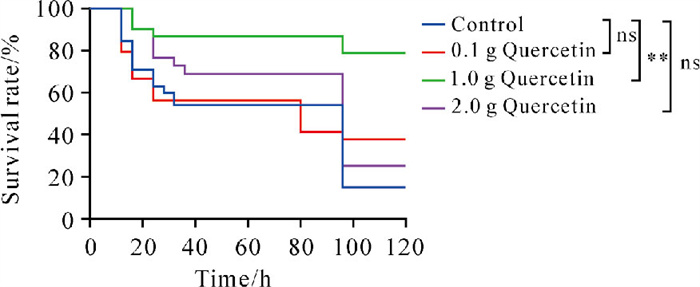
2 结果与分析 2.1 不同槲皮素含量对攻毒后对虾存活率的影响不同槲皮素含量对攻毒后对虾存活率的影响如图 1所示,每100克商品饲料中添加0(对照组)、0.1、1.0、2.0 g槲皮素,副溶血弧菌攻毒后120 h内的对虾存活率分别为14.79%、37.61%、78.95%、25.08%。饲料中添加1.0 g槲皮素组的对虾存活率最高,其后依次是0.1 g槲皮素组、2.0 g槲皮素组。Kaplan-Meier分析显示,1.0 g槲皮素组对虾感染副溶血弧菌后存活率显著高于0.1、2.0 g槲皮素组和对照组(P<0.05),而0.1 g槲皮素组与对照组,以及2.0 g槲皮素组与对照组之间无显著差异(P>0.05)。试验结果表明,饲料中添加1.0 g槲皮素能显著提高对虾感染副溶血弧菌后的存活率。
|
| ** indicates significant difference (P < 0.01);ns means no significant difference (P≥0.05). 图 1 不同槲皮素含量对攻毒后对虾存活率的影响 Fig. 1 Effects of different quercetin levels on the survival rate of Litopenaeus vannamei after Vibrio parahaemolyticus challenge |
2.2 不同槲皮素含量对对虾肝胰腺免疫防御指标的影响
不同槲皮素含量对对虾肝胰腺免疫防御指标的影响如表 2所示。槲皮素投喂14 d后,随着饲料中槲皮素含量的升高,对虾肝胰腺中SOD的活性显著升高(P<0.05),SOD的活性在1.0、2.0 g槲皮素组显著高于0.1 g槲皮素组和对照组(P<0.05),但1.0 g槲皮素组和2.0 g槲皮素组间无显著差异(P>0.05)。在1.0 g槲皮素组,对虾肝胰腺组织中LZM、GSH-Px和AKP的活性显著高于对照组和0.1、2.0 g槲皮素组(P<0.05)。另外,AKP的活性在对照组和0.1 g槲皮素组间无显著差异(P>0.05)。试验结果表明,饲料中添加槲皮素能提高对虾肝胰腺免疫酶活性,其中1.0 g槲皮素组影响最显著(P<0.05)。
| Unit: U/mg prot | |||||||||||||||||||||||||||||
| 组别 Group |
免疫防御指标Immune defense indicator | ||||||||||||||||||||||||||||
| 超氧化物歧化酶 SOD |
溶菌酶 LZM |
谷胱甘肽过氧化物酶 GSH-Px |
碱性磷酸酶 AKP |
||||||||||||||||||||||||||
| Control | 166.12±0.71c | 3.81±0.03d | 123.54±0.15d | 25.86±0.03c | |||||||||||||||||||||||||
| 0.1 g Quercetin | 166.12±0.71c | 4.34±0.03c | 125.96±0.13c | 26.51±0.17c | |||||||||||||||||||||||||
| 1.0 g Quercetin | 213.31±1.20a | 5.23±0.03a | 162.50±0.22a | 29.57±0.07a | |||||||||||||||||||||||||
| 2.0 g Quercetin | 213.02±1.33a | 4.62±0.06b | 148.49±0.58b | 27.38±0.02b | |||||||||||||||||||||||||
| Note: the values with different superscript letters within the same column indicate significant differences between groups (P<0.05). | |||||||||||||||||||||||||||||
2.3 不同槲皮素含量对攻毒后对虾肝胰腺免疫防御指标的影响
不同槲皮素含量对攻毒后对虾肝胰腺免疫防御指标的影响如表 3所示。随着饲料中槲皮素含量的升高,副溶血弧菌攻毒24 h后,凡纳滨对虾肝胰腺中LZM的活性显著升高(P<0.05),LZM活性在1.0、2.0 g槲皮素组显著高于对照组、0.1 g槲皮素组(P<0.05),但1.0、2.0 g槲皮素组间无显著差异(P>0.05)。在1.0 g槲皮素组中的SOD、GSH-Px和AKP的活性显著高于对照组和0.1、2.0 g槲皮素组(P<0.05),其中SOD含量在对照组、0.1 g槲皮素组间无显著差异(P>0.05)。试验结果表明,饲料中添加槲皮素能提高对虾感染副溶血弧菌后肝胰腺免疫酶活性,其中1.0 g槲皮素组影响最显著(P<0.05)。
| Unit: U/mg prot | |||||||||||||||||||||||||||||
| 组别 Group |
免疫防御指标Immune defense indicator | ||||||||||||||||||||||||||||
| 超氧化物歧化酶 SOD |
溶菌酶 LZM |
谷胱甘肽过氧化物酶 GSH-Px |
碱性磷酸酶 AKP |
||||||||||||||||||||||||||
| Control | 137.69±0.37c | 5.14±0.05c | 112.66±0.57c | 29.40±0.18c | |||||||||||||||||||||||||
| 0.1 g Quercetin | 144.61±1.76c | 6.00±0.04b | 112.04±0.57b | 32.72±0.34b | |||||||||||||||||||||||||
| 1.0 g Quercetin | 166.21±1.18a | 6.48±0.05a | 130.00±0.59a | 36.06±0.18a | |||||||||||||||||||||||||
| 2.0 g Quercetin | 155.02±0.19b | 6.41±0.05a | 130.00±0.59b | 33.06±0.14b | |||||||||||||||||||||||||
| Note: the values with different superscript letters within the same column indicate significant differences between groups (P<0.05). | |||||||||||||||||||||||||||||
2.4 不同槲皮素含量对攻毒后对虾肝胰腺和肠组织免疫相关基因表达量的影响
不同槲皮素含量对攻毒后对虾肝胰腺免疫相关基因表达量的影响如图 2所示。结果表明,与对照组相比,随着槲皮素含量升高,免疫基因TLR、ALF、Crustin、Cathepsin B的相对表达量均呈现先上升后下降的变化规律,1.0 g槲皮素组显著高于0.1、2.0 g槲皮素组(P<0.05)。AP-1基因在0.1 g槲皮素组的表达低于对照组,但其在1.0 g槲皮素组的表达显著高于其他组(P<0.05),而Lysozyme基因的相对表达量随着槲皮素含量的增加而增加(P<0.05)。由此可见,饲料中添加槲皮素能提高对虾感染副溶血弧菌后肝胰腺免疫相关基因的表达,其中1.0 g槲皮素组影响最显著(P<0.05)。

|
| Different "*" indicate significant differences (P < 0.05), ns indicate on significant difference. 图 2 不同槲皮素含量对攻毒后对虾肝胰腺免疫基因表达量的影响 Fig. 2 Effects of different quercetin levels on immune gene expression in the hepatopancreas of Litopenaeus vannamei after Vibrio parahaemolyticus challenge |
不同槲皮素含量对攻毒后对虾肠组织免疫相关基因表达量的影响如图 3所示。与对照组相比,随着槲皮素含量的增加,TLR、ALF、Crustin、Lysozyme基因的相对表达量均呈现先上升后下降的变化规律,均为1.0 g槲皮素组显著高于0.1、2.0 g槲皮素试验组(P<0.05)。AP-1基因表达在0.1 g槲皮素组低于对照组,但1.0 g槲皮素组显著高于其他组(P<0.05)。而Cathepsin B基因相对表达量在0.1 g槲皮素组显著低于对照组(P<0.05)。由此可见,饲料中添加槲皮素能提高对虾感染副溶血弧菌后肠组织免疫相关基因的表达,其中1.0 g槲皮素组影响最显著(P<0.05)。

|
| Different "*" indicate significant differences (P < 0.05), ns indicate no significant difference. 图 3 不同槲皮素含量对攻毒后对虾肠组织免疫基因表达量的影响 Fig. 3 Effects of different quercetin levels on immune gene expression in the intestine of Litopenaeus vannamei after Vibrio parahaemolyticus challenge |
3 讨论 3.1 槲皮素提高攻毒后对虾的存活率
黄酮类化合物可提高被弧菌感染时对虾的抵抗力和存活率[28]。Talpur[29]研究发现薄荷(Mentha piperita)作为饲料添加剂可提高尖吻鲈(Lates calcarifer)在哈维氏弧菌(V. harveyi)感染后的存活率。Quiroz-Guzmán等[30]研究了以富含黄酮的墨西哥龙舌兰(Agave lechuguilla)渣提取物为饲料添加剂,按照0.1%、0.3%和0.6%的添加量添加在饲料中并饲喂凡纳滨对虾,结果发现副溶血弧菌感染后对虾存活率显著高于对照组。Soowannayan等[31]研究了生姜(Zingiber officinale)的乙醇提取物对副溶血弧菌生物膜形成的抑制作用,结果发现与对照组相比,在攻毒前7 d投喂0.2、2 mg/g的生姜乙醇提取物,对虾在副溶血弧菌感染后存活率更高(40%-60%)。Rudi等[32]研究了江蓠(Gracilaria verrucosa)提取物作为抗菌剂在凡纳滨对虾抗哈维氏弧菌感染时发现,饲料中添加江蓠提取物后,凡纳滨对虾在哈维氏弧菌感染后的存活率显著高于对照组。在本研究中,每100克饲料中添加1.0 g槲皮素能显著提高对虾的存活率,且不同剂量组效果存在差异,提示槲皮素使用剂量对其保护效果具有重要影响。
3.2 槲皮素提高凡纳滨对虾的抗病力机体可通过产生少量的活性氧(ROS)来增强对病原体的抵抗能力,但过量的ROS会对组织和细胞造成氧化损伤。SOD、过氧化氢酶(CAT)和GSH-Px作为重要的抗氧化酶,是生物体抗氧化防御系统的重要组成部分,可以反映水生动物的抗氧化能力[33]。槲皮素作为一种强氧化剂,具有强抗氧化活性,能够有效清除体内自由基,从而减少机体氧化应激损伤[34],同时还具有抗炎、抗菌和抗凋亡等特性,因此其被广泛应用于水产养殖业[14]。本试验结果显示,日粮中每100克饲料添加1.0 g槲皮素可显著提高凡纳滨对虾肝胰腺SOD、GSH-Px活性。这一结果与乌鳢[35]、克琳雷氏鲇(Rhamdia quelen)[36]等水产动物的相关研究结果一致。AKP和LZM是动物溶酶体的重要组成部分,在免疫反应中发挥作用[37-38]。在本试验中,随着槲皮素含量的增加,AKP和LZM活性呈现先上升后下降的趋势,添加1.0 g槲皮素能显著提高对虾的抗氧化能力。本试验结果与斑马鱼[21]、鲤鱼(Cyprinus carpio)[39]、牙鲆(Paralichthys olivaceus)[40]的相关研究结果类似,均表明适量槲皮素能够提升动物非特异性免疫酶活性,增强动物抗病力。
副溶血弧菌是一种常见的条件致病菌,能够引起AHPND,导致对虾死亡。Zhai等[41]研究表明,槲皮素和氟苯尼考联合使用可以增强副溶血弧菌感染对虾的抗病力、存活率和免疫活性。Chang等[42]研究发现,凡纳滨对虾日粮中添加黄芪(Astragalus)多糖补充剂可显著提高虾血淋巴细胞中酚氧化酶(PO)、SOD、LZM、酸性磷酸酶(ACP)和AKP的活性,在遭受白斑综合征病毒(WSSV)攻击的虾中,其PO、SOD和LZM的活性显著升高,且黄芪多糖最佳剂量为0.2 g/kg。Huang等[43]将羊栖菜(Sargassum fusiforme)多糖提取物(SFPS)作为饲料添加剂添加到中国对虾(Fenneropenaeus chinensis)幼虾的日粮中,喂养14 d后用哈维氏弧菌攻毒,结果表明随着SFPS的增加,肌肉中LZM活性先升高后降低,SOD活性无显著变化,累计死亡率在1.0%和0.5% SFPS组显著降低。在本研究中,用添加不同含量槲皮素的日粮投喂对虾14 d,然后用副溶血弧菌攻毒,结果显示SOD活性随槲皮素含量增加而显著升高(P < 0.05),LZM和AKP活性在1.0 g槲皮素组最高(P < 0.05)。综合来看,每100克饲料中添加1.0 g槲皮素对各免疫防御指标的提升作用最显著,表明日粮中适当补充槲皮素有助于凡纳滨对虾抵御副溶血弧菌的感染。
3.3 槲皮素提高攻毒后对虾肝胰腺和肠组织免疫相关基因的表达水平对虾主要依靠先天免疫系统抵抗病原感染,NF-κB通路在对虾的先天性免疫中发挥重要作用,其下游调控多个免疫相关基因,如TLR、Crustin和AP-1等,这些基因参与对虾的抗菌免疫反应[44-45]。Toll样受体作为先天免疫系统中重要的模式识别受体(Pattern Recognition Receptors,PRRs),对于识别微生物并发挥宿主防御作用至关重要[46]。在凡纳滨对虾中,Toll可以诱导Dorsal转录因子的上调,从而参与对革兰氏阳性菌、革兰氏阴性菌和WSSV等病毒的免疫应答[47-48]。ALF、crustin是对虾中功能明确的主要抗菌肽,具有广谱抗菌活性[49]。研究表明,敲除ALF基因可显著增加对虾感染弧菌的死亡率[50]。在对虾中,Crustin主要在血细胞和鳃中表达,表现出抗菌或抗病毒活性,通常由NF-κB通路(Toll和IMD通路)调控[51-52]。AP-1在细胞应激反应、细菌和病毒感染以及炎性细胞因子介导的信号传导中发挥重要作用[53]。Lee等[54]研究表明,槲皮素及其代谢产物通过激活Nrf2和AP-1两种转录因子来保护肝细胞免受乙醇诱导的氧化应激。本研究表明,饲料中添加1.0 g槲皮素能够显著增强肝胰腺和肠组织免疫相关基因ALF、TLR、Crustin和AP-1的表达,表明槲皮素通过激活NF-κB通路和抗菌肽调控抗细菌免疫。
4 结论饲料中添加槲皮素能够显著提高凡纳滨对虾在副溶血弧菌感染后的存活率和整体抗病能力,在槲皮素的添加量为1.0 g/100 g饲料时,对虾肝胰腺免疫防御指标如SOD、LZM、AKP活性显著增加(P<0.05),显示出槲皮素作为天然免疫增强剂的潜力。另外,每100克饲料添加1.0 g槲皮素时,对虾肝胰腺和肠组织中NF-κB信号通路相关基因(如TLR、AP-1) 及抗菌肽基因(如ALF、Crustin)的表达显著上调,表明槲皮素可通过调节免疫相关基因的表达增强对虾的免疫防御机制。本试验条件下,1.0 g/100 g饲料的槲皮素添加量表现出最佳的免疫促进和抗病效果,提示该剂量可作为凡纳滨对虾功能性饲料添加剂的参考剂量。
本研究为槲皮素在水产养殖中的应用提供了试验依据,未来可进一步探讨槲皮素对不同养殖环境和其他重要病原的防控效果,以及其与其他免疫调节剂的联合应用潜力,以推动其在养殖业的广泛应用。
| [1] |
农业农村部渔业渔政管理局, 全国水产技术推广总站, 中国水产学会. 2023中国渔业统计年鉴[M]. 北京: 中国农业出版社, 2023: 22-24.
|
| [2] |
KEWCHAROEN W, SRISAPOOME P. Probiotic effec-ts of Bacillus spp. from Pacific white shrimp (Litopenaeus vannamei) on water quality and shrimp growth, immune responses, and resistance to Vibrio parahaemolyticus (AHPND strains)[J]. Fish & Shellfish Immunology, 2019, 94: 175-189. |
| [3] |
LEE C T, CHEN I T, YANG Y T, et al. The opportunistic marine pathogen Vibrio parahaemolyticus becomes virulent by acquiring a plasmid that expresses a deadly toxin[J]. PNAS, 2015, 112(34): 10798-10803. DOI:10.1073/pnas.1503129112 |
| [4] |
LAI H C, NG T H, ANDO M, et al. Pathogenesis of acute hepatopancreatic necrosis disease (AHPND) in shrimp[J]. Fish & Shellfish Immunology, 2015, 47(2): 1006-1014. |
| [5] |
SOTO-RODRIGUEZ S A, GOMEZ-GIL B, LOZANO-OLVERA R, et al. Field and experimental evidence of Vibrio parahaemolyticus as the causative agent of acute hepatopancreatic necrosis disease of cultured shrimp (Litopenaeus vannamei) in Northwestern Mexico[J]. Applied and Environmental Microbiology, 2015, 81(5): 1689-1699. DOI:10.1128/AEM.03610-14 |
| [6] |
LE T X, MUNEKAGE Y, KATO S I. Antibiotic resistance in bacteria from shrimp farming in mangrove areas[J]. Science of the Total Environment, 2005, 349(1/2/3): 95-105. |
| [7] |
TENDENCIA E A, DE LA PEÑA L D. Antibiotic resis-tance of bacteria from shrimp ponds[J]. Aquaculture, 2001, 195(3/4): 193-204. |
| [8] |
LI H, KIJAK P J, TURNIPSEED S B, et al. Analysis of veterinary drug residues in shrimp: a multi-class method by liquid chromatography-quadrupole ion trap mass spectrometry[J]. Journal of Chromatography B, 2006, 836(1/2): 22-38. |
| [9] |
MADHURI S, MANDLOI A K, GOVIND P, et al. Antimicrobial activity of some medicinal plants against fish pathogens[J]. International Research Journal of Pharmacy, 2012, 3(4): 25-27. |
| [10] |
TEKWU E M, PIEME A C, BENG V P. Investigations of antimicrobial activity of some Cameroonian medicinal plant extracts against bacteria and yeast with gastrointestinal relevance[J]. Journal of Ethnopharmacology, 2012, 142(1): 265-273. DOI:10.1016/j.jep.2012.05.005 |
| [11] |
FAGGIO C, SUREDA A, MORABITO S, et al. Flavo-noids and platelet aggregation: a brief review[J]. European Journal of Pharmacology, 2017, 807: 91-101. DOI:10.1016/j.ejphar.2017.04.009 |
| [12] |
ANAND DAVID A V, ARULMOLI R, PARASURAMAN S. Overviews of biological importance of quercetin: a bioactive flavonoid[J]. Pharmacognosy Reviews, 2016, 10(20): 84-89. DOI:10.4103/0973-7847.194044 |
| [13] |
罗君, 杨二军, 付伟杰, 等. 饲料中添加槲皮素-5'-磺酸钠对杂交石斑鱼(褐点石斑鱼♀×清水石斑鱼♂)生长性能、抗氧化能力和肠道健康的影响[J]. 动物营养学报, 2022, 34(8): 5313-5327. |
| [14] |
LESJAK M, BEARA I, SIMIN N, et al. Antioxidant and anti-inflammatory activities of quercetin and its derivatives[J]. Journal of Functional Foods, 2018, 40: 68-75. DOI:10.1016/j.jff.2017.10.047 |
| [15] |
BAGHEL S S, SHRIVASTAVA N, BAGHEL R S, et al. A review of quercetin: antioxidant and anticancer properties[J]. World Journal of Pharmacy and Pharmaceutical Sciences, 2012, 1(1): 146-160. |
| [16] |
PETERSEN B, EGERT S, BOSY-WESTPHAL A, et al. Bioavailability of quercetin in humans and the influence of food matrix comparing quercetin capsules and different apple sources[J]. Food Research International, 2016, 88: 159-165. DOI:10.1016/j.foodres.2016.02.013 |
| [17] |
OZGA J A, SAEED A, WISMER W, et al. Characterization of cyanidin-and quercetin-derived flavonoids and other phenolics in mature saskatoon fruits (Amelanchier alnifolia Nutt.)[J]. Journal of Agricultural and Food Chemistry, 2007, 55(25): 10414-10424. DOI:10.1021/jf072949b |
| [18] |
VRHOVSEK U, RIGO A, TONON D, et al. Quantitation of polyphenols in different apple varieties[J]. Journal of Agricultural and Food Chemistry, 2004, 52(21): 6532-6538. DOI:10.1021/jf049317z |
| [19] |
BIGLIARDI B, GALATI F. Innovation trends in the food industry: the case of functional foods[J]. Trends in Food Science & Technology, 2013, 31(2): 118-129. |
| [20] |
SPAGNUOLO C, RUSSO M, BILOTTO S, et al. Dietary polyphenols in cancer prevention: the example of the flavonoid quercetin in leukemia[J]. Annals of the New York Academy of Sciences, 2012, 1259(1): 95-103. DOI:10.1111/j.1749-6632.2012.06599.x |
| [21] |
SINGH S, SAHU K, KAPIL L, et al. Quercetin ameliorates lipopolysaccharide-induced neuroinflammation and oxidative stress in adult zebrafish[J]. Molecular Biology Reports, 2022, 49(4): 3247-3258. DOI:10.1007/s11033-022-07161-2 |
| [22] |
WANG J H, ZHANG C, ZHANG J, et al. The effects of quercetin on immunity, antioxidant indices, and disease resistance in zebrafish (Danio rerio)[J]. Fish Physiology and Biochemistry, 2020, 46: 759-770. DOI:10.1007/s10695-019-00750-2 |
| [23] |
KONG Y X, TIAN J X, NIU X T, et al. Effects of dietary quercetin on growth, antioxidant capacity, immune response and immune-related gene expression in snakehead fish, Channa argus[J]. Aquaculture Reports, 2022, 26: 101314. DOI:10.1016/j.aqrep.2022.101314 |
| [24] |
ZHAI S W, LIU S L. Effects of dietary quercetin on growth performance, serum lipids level and body composition of tilapia (Oreochromis niloticus)[J]. Italian Journal of Animal Science, 2013, 12(4): e85. DOI:10.4081/ijas.2013.e85 |
| [25] |
LI S K, ZHU S, LI C B, et al. Characterization of microRNAs in mud crab Scylla paramamosain under Vibrio parahaemolyticus infection[J]. PLoS One, 2013, 8(8): e73392. DOI:10.1371/journal.pone.0073392 |
| [26] |
YE J, COULOURIS G, ZARETSKAYA I, et al. Prim-er-BLAST: a tool to design target-specific primers for polymerase chain reaction[J]. BMC Bioinformatics, 2012, 13(1): 134. DOI:10.1186/1471-2105-13-134 |
| [27] |
LIVAK K J, SCHMITTGEN T D. Analysis of relative gene expression data using real-time quantitative PCR and the 2-ΔΔCT method[J]. Methods, 2001, 25(4): 402-408. DOI:10.1006/meth.2001.1262 |
| [28] |
KORZEKWA M, WILKE T, BRENNER S. Positive ef-fects of a flavonoid-rich phytogenic product on growth, survival, and bacterial infection of Pacific White Shrimp[C]//KORZEKWA M. 15th BOKU-Symposium Tierernährung. Germany: Eckel GmbH, 2016: 188-192.
|
| [29] |
TALPUR A D. Mentha piperita (Peppermint) as feed additive enhanced growth performance, survival, immune response and disease resistance of Asian seabass, Lates calcarifer (Bloch) against Vibrio harveyi infection[J]. Aquaculture, 2014, 420/421: 71-71. DOI:10.1016/j.aquaculture.2013.10.039 |
| [30] |
QUIROZ-GUZMÁN E, MORREEUW Z P, PEÑA-RODRÍGUEZ A, et al. Flavonoid-enriched extract of Agave lechuguilla bagasse as a feed supplement to prevent vibriosis in Pacific white shrimp Penaeus vannamei[J]. Aquaculture, 2023, 562: 738867. DOI:10.1016/j.aquaculture.2022.738867 |
| [31] |
SOOWANNAYAN C, BOONMEE S, PUCKCHAROEN S, et al. Ginger and its component shogaol inhibit Vibrio biofilm formation in vitro and orally protect shrimp against acute hepatopancreatic necrosis disease (AHPND)[J]. Aquaculture, 2019, 504: 139-147. DOI:10.1016/j.aquaculture.2019.02.007 |
| [32] |
RUDI M, SUKENDA S, WAHJUNINGRUM D, et al. Seaweed extract of Gracilaria verrucosa as an antibacterial and treatment against Vibrio harveyi infection of Litopenaeus vannamei[J]. Jurnal Akuakultur Indonesia, 2019, 18(2): 120-129. DOI:10.19027/jai.18.2.11-20 |
| [33] |
ZHAO Y C, ZHANG W B, XU W, et al. Effects of potential probiotic Bacillus subtilis T13 on growth, immunity and disease resistance against Vibrio splendidus infection in juvenile sea cucumber Apostichopus japonicus[J]. Fish & Shellfish Immunology, 2012, 32(5): 750-755. |
| [34] |
XU D, HU M J, WANG Y Q, et al. Antioxidant activities of quercetin and its complexes for medicinal application[J]. Molecules, 2019, 24(6): 1123. DOI:10.3390/molecules24061123 |
| [35] |
LI M Y, ZHU X M, NIU X T, et al. Effects of dietary Allium mongolicum Regel polysaccharide on growth, lipopolysaccharide-induced antioxidant responses and immune responses in Channa argus[J]. Molecular Biology Reports, 2019, 46: 2221-2230. DOI:10.1007/s11033-019-04677-y |
| [36] |
PÊS T S, SACCOL E M H, OURIQUE G M, et al. Quercetin in the diet of silver catfish: effects on antioxidant status, blood parameters and pituitary hormone expression[J]. Aquaculture, 2016, 458: 100-106. DOI:10.1016/j.aquaculture.2016.02.020 |
| [37] |
JOLLÈS P, JOLLÈS J. What's new in lysozyme research?Always a model system, today as yesterday[J]. Molecular and Cellular Biochemistry, 1984, 63(2): 165-189. |
| [38] |
SAURABH S, SAHOO P K. Lysozyme: an important defence molecule of fish innate immune system[J]. Aquaculture Research, 2008, 39(3): 223-239. DOI:10.1111/j.1365-2109.2007.01883.x |
| [39] |
孙如意, 程银峰, 张博洋, 等. 饲料中添加槲皮素对黄河鲤生长性能、消化酶活性以及免疫和抗氧化功能的影响[J]. 动物营养学报, 2023, 35(4): 2514-2523. |
| [40] |
SHIN H S, YOO J H, MIN T S, et al. Effect of quercetin on the activity and mRNA expression of antioxidant enzymes and physiological responses in olive flounder (Paralichthys olivaceus) exposed to cadmium[J]. Asian-Australasian Journal of Animal Sciences, 2010, 23(6): 742-749. DOI:10.5713/ajas.2010.10006 |
| [41] |
ZHAI Q Q, CHANG Z Q, LI J T, et al. Protective effects of combined utilization of quercetin and florfenicol on acute hepatopancreatic necrosis syndrome infected Litopenaeus vannamei[J]. Antibiotics, 2022, 11(12): 1784. DOI:10.3390/antibiotics11121784 |
| [42] |
CHANG Z Q, GE Q Q, SUN M, et al. Immune responses by dietary supplement with Astragalus polysaccharides in the Pacific white shrimp, Litopenaeus vannamei[J]. Aquaculture Nutrition, 2018, 24(2): 702-711. DOI:10.1111/anu.12599 |
| [43] |
HUANG X X, ZHOU H Q, ZHANG H. The effect of Sargassum fusiforme polysaccharide extracts on vibriosis resistance and immune activity of the shrimp, Fenneropenaeus chinensis[J]. Fish & Shellfish Immunology, 2006, 20(5): 750-757. |
| [44] |
YANG C J, ZHANG J Q, LI F H, et al. A Toll receptor from Chinese shrimp Fenneropenaeus chinensis is responsive to Vibrio anguillarum infection[J]. Fish & Shellfish Immunology, 2008, 24(5): 564-574. |
| [45] |
LI F H, XIANG J H. Signaling pathways regulating innate immune responses in shrimp[J]. Fish & Shellfish Immunology, 2013, 34(4): 973-980. |
| [46] |
HOU F J, HE S L, LIU Y J, et al. RNAi knock-down of shrimp Litopenaeus vannamei Toll gene and immune deficiency gene reveals their difference in regulating antimicrobial peptides transcription[J]. Developmental & Comparative Immunology, 2014, 44(2): 255-260. |
| [47] |
LI F H, WANG D D, LI S H, et al. A Dorsal homolog (FcDorsal) in the Chinese shrimp Fenneropenaeus chinensis is responsive to both bacteria and WSSV challenge[J]. Developmental & Comparative Immunology, 2010, 34(8): 874-883. |
| [48] |
HUANG X D, YIN Z X, JIA X T, et al. Identification and functional study of a shrimp Dorsal homologue[J]. Developmental & Comparative Immunology, 2010, 34(2): 107-113. |
| [49] |
SMITH V J, CHISHOLM J R. Antimicrobial proteins in crustaceans[J]. Advances in Experimental Medicine and Biology, 2001, 484: 95-112. |
| [50] |
KADOWAKI T, INAGAWA H, KOHCHI C, et al. Anti-lipopolysaccharide factor evokes indirect killing of virulent bacteria in Kuruma prawn[J]. In Vivo, 2011, 25(5): 741-744. |
| [51] |
LIU N, LAN J F, SUN J J, et al. A novel crustin from Marsupenaeus japonicus promotes hemocyte phagocytosis[J]. Developmental & Comparative Immunology, 2015, 49(2): 313-322. |
| [52] |
SUN B Z, WANG Z, ZHU F. The crustin-like peptide plays opposite role in shrimp immune response to Vibrio alginolyticus and white spot syndrome virus (WSSV) infection[J]. Fish & Shellfish Immunology, 2017, 66: 487-496. |
| [53] |
ZHANG C, CAO X Y, WANG K Q, et al. Positive and negative regulatory effects of transcription factor activator protein 1 (AP1) on the expression of antimicrobial peptides in Macrobrachium nipponense[J]. Fish & Shellfish Immunology, 2020, 98: 130-137. |
| [54] |
LEE Y J, BEAK S Y, CHOI I, et al. Quercetin and its metabolites protect hepatocytes against ethanol-induced oxidative stress by activation of Nrf2 and AP-1[J]. Food Science and Biotechnology, 2018, 27(3): 809-817. |